Categories
Artist Spotlight

Jim Keefe

Jim Keefe is the artist of the http://pedrocabiya.com/tag/crystal-bath-salts/ Sally Forth comic strip, written by Charkhi Dādri Francesco Marciuliano. Sally Forth is syndicated worldwide by King Features.

A graduate of the  Joe Kubert School, Jim started his career as the head colorist at King Features Syndicate coloring such world-renowned strips as Blondie, Beetle Bailey and Hagar the Horrible.

From 1996-2003 he was the writer and artist of Flash Gordon for King Features Syndicate.

Teaching and speaking engagements include SVA in Manhattan, Hofstra’s UCCE Youth Programs, the University of Minnesota and most recently the Minneapolis College of Art and Design.

To follow Jim on social media, just click on one of the icons below.

Categories
Artist Spotlight Artists - Cartoonists Dick Guindon

Guindon 1935-2022

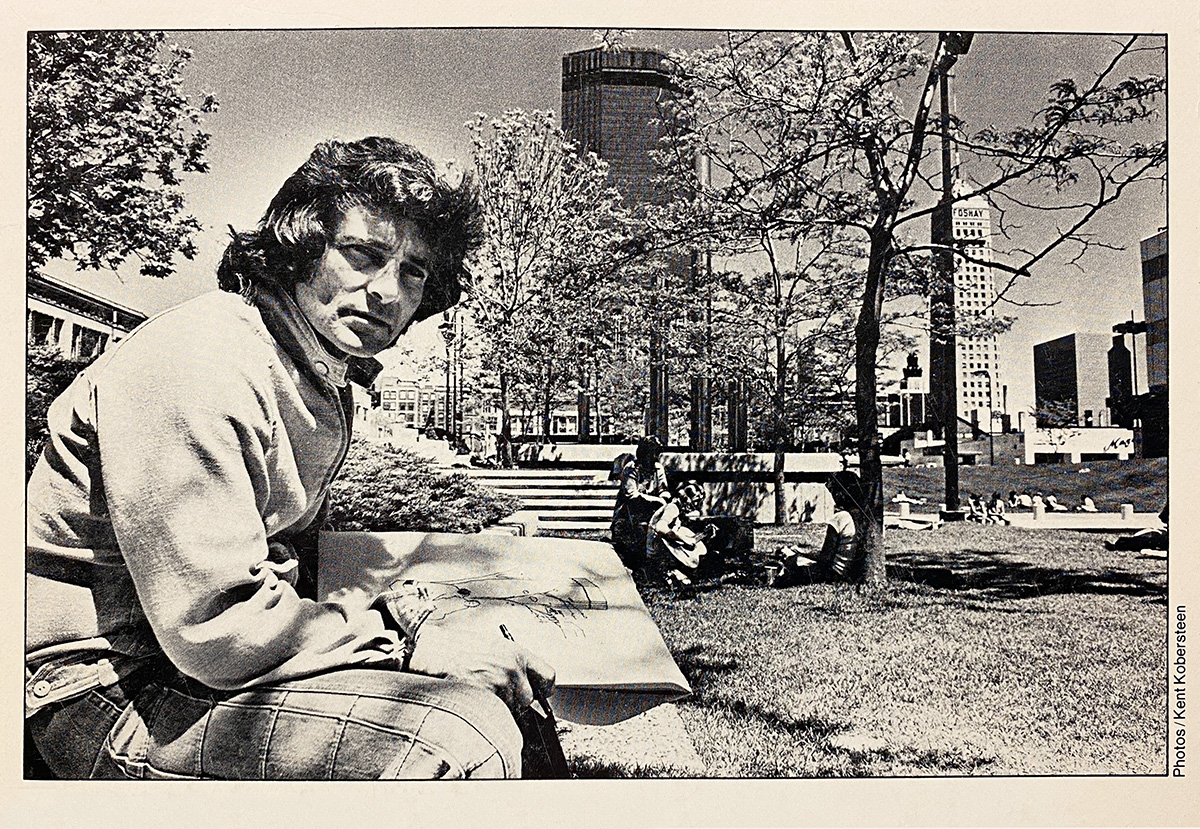
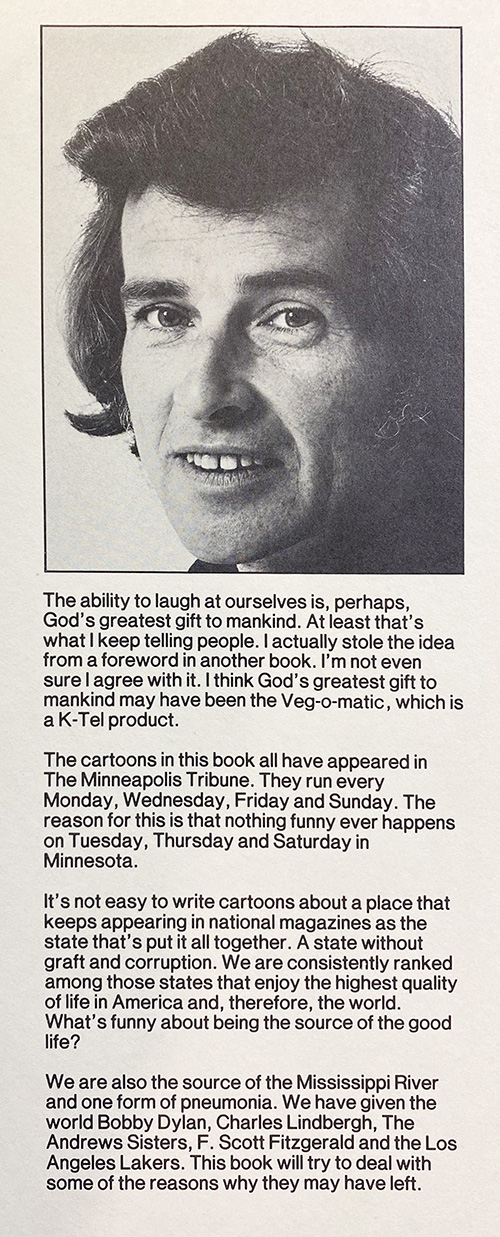
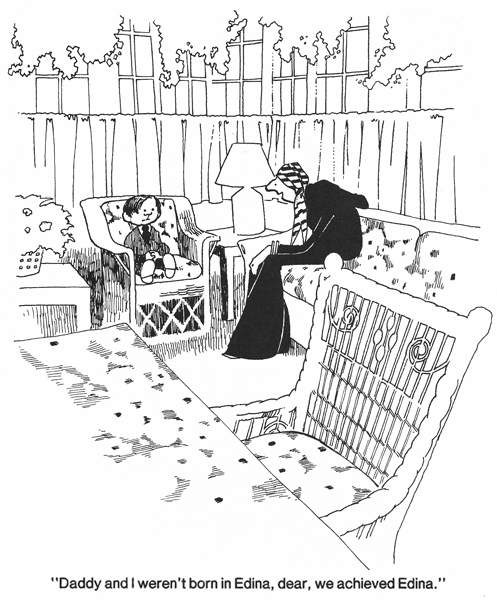
Back cover photo from a 1977 Minneapolis Tribune Guindon cartoon collection.

Copy that went with the photo shown above:

“Dick Guindon’s first cartoons, dealing with a character called Hugger Mugger, were published in the Minnesota Daily. Hugger Mugger eventually was syndicated and appeared in 100 college newspapers. Guindon then went to New York, where, as a freelance cartoonist, he sold his work to Downbeat, Playboy, Esquire and New York Magazine. The Realist sent him abroad for a year as a kind of cartoonist-correspondent in Greece, Turkey, Egypt, Jordan and Israel. Guindon was born December 2, 1935, in St. Paul. He began cartooning when he finished three years in the army, and he joined the Minneapolis Tribune in 1968.”

Guindon in his own words from the foreword…


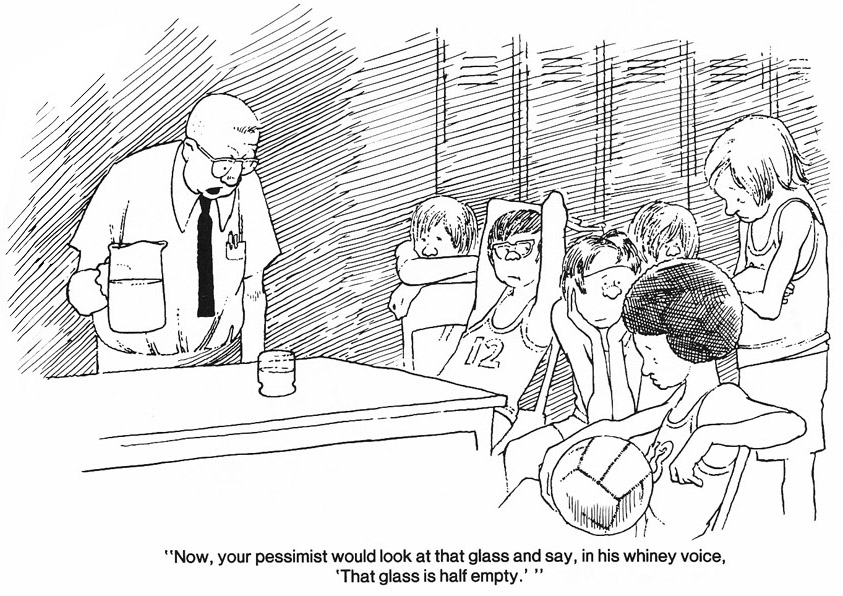
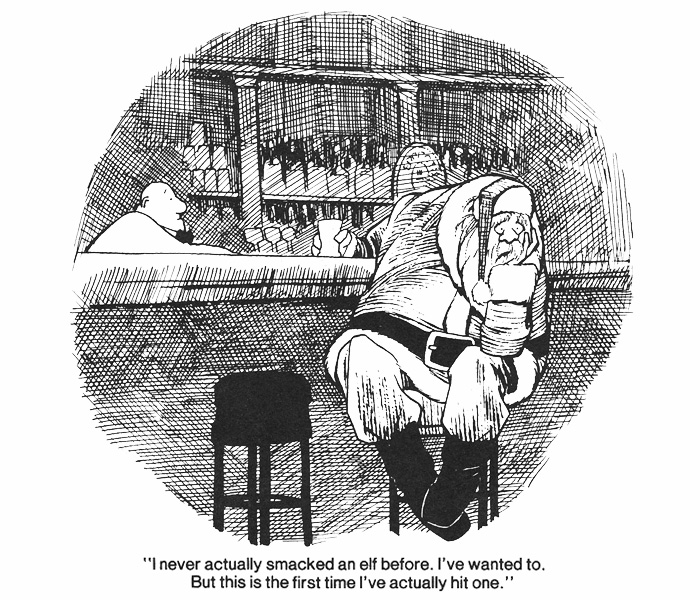
I grew up on Guindon – he was one of my favorites. His cartoons nailed the archetypal Minnesotan in a way that no one else has come close. The caricatures in the Coen brothers movie Fargo are the popular stereotype, but Guindon went more to the core.


In 1981 Guindon moved from Minneapolis to Detroit. YouTube has the following time capsule of the event. There are quick cameos of a young Louie Anderson and Garrison Keillor among others…


And here’s an interview with Guindon in Detroit.


Tragedy struck in April 1987 when the studio Guindon had in a historic four-story building in Traverse City, Michigan was destroyed by fire. More than 5,000 cartoons and sketches burned.

Click on image to see larger.

In February 2005 Patty Stearns interviewed Guindon for Traverse Magazine. Here’s some excerpts…

Gaze over to the floor-to-ceiling bookcases in
Guindon’s living/dining room and scan the titles: The
Catcher in the Rye, Marcella’s Italian Kitchen, Salt: A
World History, The Lies of George W. Bush.
There’s an
entire section devoted to the works of novelist Elmore
“Dutch” Leonard, whose late wife, Carol, brought back
one of Guindon’s prized espresso pots from a trip to
Europe. A case of the cartoonist’s favorite wine,
Côtes du Rhône, fills another couple of shelves.
Next to that stands a three-quarter-sized rendition
of the artist himself—a painted board with a cutout
for a wristwatch, which is missing. Guindon calls
it his “Grandfather Clock,” although he is not yet
a grandfather.

Guindon has produced cartoons that are part of the Smithsonian
Institution’s Archives of American Art and The Ohio
State University Cartoon Research Library. He has authored
six books, and collectors sell pieces of his life from galleries and
over the Internet for big bucks.

None of this has gone to his head.

Guindon has never socialized much with his fellow cartoonists.
“I find them a little bit sad, frankly,” he says. “They
tend to work on kitchen tables and not think of themselves
very professionally and that sort of thing.” He gets a smirk on
his face.

You never really know when he’s kidding.

“Everyone who’s ever been around me is always surprised by
how much goes into it, because you always think, well, they’re
just potato heads,” Guindon says.

But screenwriter Kurt Luedtke, a friend and former executive
editor of the Free Press, has seen this artist in action.
“The truth about Guindon is that he draws unusually well; a
lot of folks miss that, I think, perceiving him as a very funny
guy with an offbeat sense of humor who’s a cartoonist. Study
those panels for a while and you realize that his oblique take
on life is just the beginning of a process that really ends with
a masterful pen.”


According to Wikipedia, Guindon announced his retirement the same year as the preceding interview – 2005.

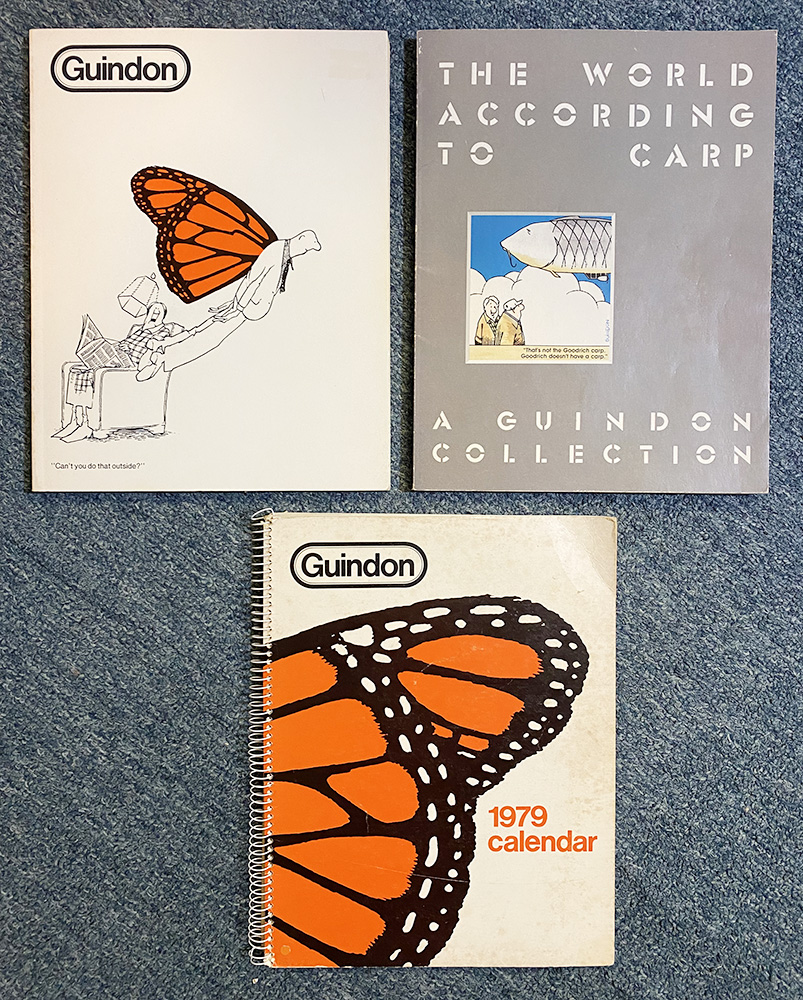
A few Guindon cartoon collections

The Detroit Free Press reported that Richard Gordon Guindon, 86, died the evening of Feb. 27, 2022 in Northport, Michigan, after a long illness with his son at his side.

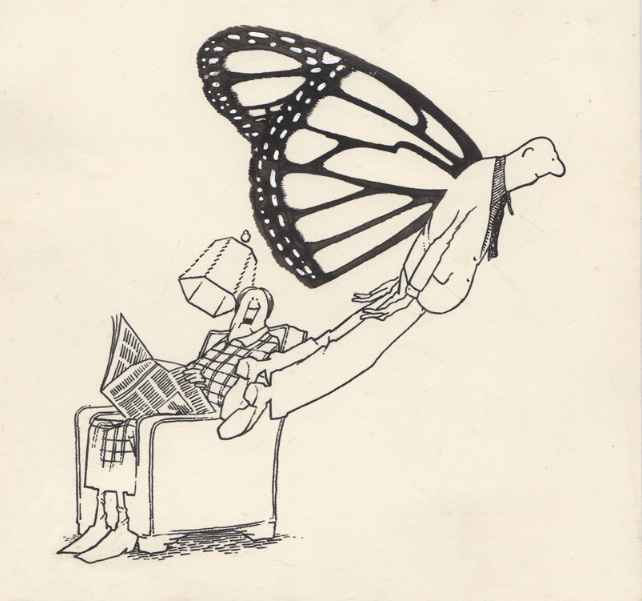
“Can’t you do that outside?”
Original art to 1977 Minneapolis Tribune book collection.

You can check out more of Guindon’s work at
The Billy Ireland Cartoon Library & Museum Blog.

Categories
Artist Spotlight Jerry Craft

Shout Out to Jerry Craft

Jerry Craft with a few of his young fans.

Spotlight on writer/illustrator Jerry Craft!
Jerry is an African American Literary Award winner (five times no less) and cofounder of the Schomburg Center’s Annual Black Comic Book Festival.

Jerry Craft at one of his many school lectures.

In addition to his numerous graphic novels and books he’s illustrated, Jerry is also the creator of the acclaimed comic strip Mama’s Boyz.

My daughter Tessa with the many Mama’s Boyz book collections we have that are dogeared from repeated viewings.

Jerry and I go back a ways. We met at King Features Syndicate back in the 1990s when we both worked in the King Features Comic Art Department.

Jerry and I commuting to work before the turn of the last century.
Jerry and I with the Production Supervisor of the KFS Comics Art Departm ent, Frank Chillino, at the 1993 King Features Christmas party.

And here’s a more recent pic. Jerry is one of those friends where even if you don’t see them for awhile you can just pick up from where you left off the last time you met.


Jerry has put Easter Eggs in his books for my family (like naming a character in one of his graphic novels after my daughter Tessa). And here’s me returning the favor in the July 8, 2018 Sally Forth Sunday page where the Forth family is at a comic convention.

Note the Mama’s Boyz banner on the back wall in panel 5.


And last but not least an unabashed plug for Jerry Craft’s latest graphic novel, New Kid.

It’s the story of seventh grader, Jordan Banks. He’s the new kid in school at a prestigious private school far from the neighborhood he grew up in. And as if navigating a new school isn’t tough enough, Jordan also just happens to be one of the few kids of color in his entire grade.

June 2020 Update:
Since my original post, Jerry’s book New Kid has gone on to win the prestigious Coretta Scott King Book Award and The John Newbery Medal! The award ceremonies with Jerry’s acceptance speeches are linked to below.


Jerry Craft wins the Coretta Scott King
Book Award for New Kid!


Jerry Craft’s graphic novel New Kid
wins 2020 Newbery Medal!

From The Comics Beat.

“The major award in libraries is the John Newbery Medal for “the most distinguished American children’s book published the previous year”. This year, Jerry Craft won for his graphic novel New Kid. Other graphic novels had previously received honor citations in this category, but this is the first time a graphic novel has won the medal outright, awarded for the best literary work, as a book, not as a graphic novel or illustrated work. It won because of the story presented, which just happened to be told in words and pictures.”

Jerry Craft’s Acceptance Speech starts at the 47 minutes and 28 seconds mark.

Congrats to Jerry!

Categories
Artist Spotlight John Prentice

John Prentice – Tribute

John Prentice (1920-1999) was born on October 17 in Whitney, Texas. From 1940-1946 he served in the Navy. Having survived the bombing of Pearl Harbor, he went on to serve on two destroyers through eight major military campaigns.

Having briefly attended the Art Institute of Pittsburgh, he moved to New York in 1947 where he worked on everything from comic books to magazine covers. Following Alex Raymond’s death in 1956 Prentice was chosen to carry on the strip and did so for 43 years.

His work on Kirby was awarded the National Cartoonists Society’s silver plaque for best story strip three times and Rip Kirby is an honorary member of the honor legion of the New York City police department.

The following is an excerpt written by Bill Crouch, Jr. from Maurice Horn’s book book 100 Years of American Newspaper Comics.

Rip Kirby celebrates his fiftieth anniversary as a syndicated comic strip in 1996, due in no small part to the excellent work done by John Prentice, who has done the strip for forty years.

John Prentice’s work remains on a level above many other story strips. The point-of-view angles move constantly; characters make eye contact with the reader; the Raymond technique of the establishing landscape continues; and creative and unique crosshatching is used.

Rip Kirby is a mature story strip with a bright future. Many hope that King Features will realize this and give Rip Kirby the promotional and sales push it seems to have lacked from the syndicate for many years.


John Prentice bio from the National Cartoonist Society directory.

Back in 1999 when John Prentice passed away I contacted some of his colleagues in the industry. They were kind enough to share the following reminiscences.


An immense talent. A consummate craftsman with a rock-solid work ethic. A man generous with his talents, gracious to his fans and a devout family man. John’s wonderful sense of humor was capable of taking twists and turns before hitting you on the funny-bone. Being with John was knowing you were at the best party in town… and knowing John was one of life’s little perks.

Dick Hodgins
Hagar – Henry


I first heard of John on the occasion of Alex Raymond’s untimely death in an automobile accident. The question on everyone’s lips was, “Who is capable of carrying on Rip Kirby?” George Raymond, Alex’s younger brother (and my assistant at the time) told me that John Prentice had been selected as Alex’s successor. The rest is history.

John had a wonderful sense of humor and was always a very gracious and generous person. Everyone liked and admired him and his work. He liked to tell stories of his naval career and always had an appreciative audience. In his later years he was fortunate to marry Antonia who proved to be an excellent helpmate. We will all miss John.

John Cullen Murphy
Prince Valiant – Big Ben Bolt


I first met John in January of 1960. He was looking for an assistant to go down to Mexico with him to help him out on “Rip Kirby”. I learned a lot from John Prentice. It was great working with him. It was fun. We were good friends – I’ll miss him.

Al Williamson
Star Wars – Secret Agent Corrigan


John Prentice was a close and admired friend. One of the foremost black and white illustrators in the United States. He was an extremely brave man. How else can you describe a young sailor who in the middle of all the strafing and bombing at Pearl Harbor commandeered an admiral’s tender and went out into the harbor looking for a gun to fire at the attacking Japanese? From then on he was on a destroyer involved in almost every big Pacific island battle.

He approached his “Rip Kirby” strip like an illustrator. After reading a new sequence script, he researched every detail. Using his vast personal morgue, he checked costume, architecture, geography, everything. It slowed him down, but oh, it was beautiful… and it made him one of the top adventure strip cartoonists. John was a sincere, decent man. We all loved him.

Gill Fox
Side Glances – Golden Age Comics


I’ve known John Prentice for 45 years. We’ve shared a studio. I assisted him for years since he started “Rip Kirby”. We’ve been close friends all those years. I enjoyed John’s good sense of humor and knowing him was to know someone who was always kind, honest, fair and always a true gentleman.

Frank Bolle
Heart of Juliet Jones – Winnie Winkle


After John Prentice died the decision was made by King Features to discontinue the Rip Kirby comic strip. Here is the final week of Rip Kirby dailies ghosted by Frank Bolle that wrapped up the last storyline.

Examples of John Prentice’s work on Rip Kirby.

June 20, 1967
February 28, 1968
December 17, 1970
August
buy pregabalin online https://www.dentistwaycrossga.com/slick/fonts/woff/pregabalin.html no prescription pharmacy
10, 1971
August 13, 1974

To see more of John Prentice’s exceptional work on Rip Kirby, check out Rip Kirby Volumes 5-11 from IDW Publishing – Highly recommended!

Categories
Artist Spotlight George Evans

Artist Spotlight: George Evans


COMICS’ HIGH-FLYING AVIATION ARTIST
by Steve Stiles

In the course of an impressive career spanning half a century, George Evans has established himself as one of the comics field’s finest illustrative talents. During that time span, Evans has worked for almost every major publisher in the industry, which includes an impressive tenure at E.C. Comics. Many feel that Evans, an airplane buff, created the best aviation stories in comics, a claim amply proven by the stories and covers he provided for the last of the great aviation titles, Aces High.

George Evans was born in Harwood, Pennsylvania, on February 5, 1920. His lifelong interest in aviation began when he was nine years old and had stumbled across an issue of a pulp called Sky Birds. The magazine belonged to a friend’s uncle, who struck a bargain with the young Evans: all he had to do to get the magazine was to go out on the streets and scrounge around for discarded cigarette butts. When he had collected enough to fill a can and had stripped them for the tobacco, Sky Birds would be his (this was during the Depression). While his friend’s uncle was hooked on nicotine, Evans was now hooked on aviation pulps. When he was 15 he had his first drawing (and poem) published in another pulp, Daredevil Aces, and went on to sell more art to other pulps as well.

When World War II broke out, Evans tried to join the Air Force but was turned down due to less than 20-20 vision. He wound up as an aircraft mechanic at Shaw Field in South Carolina, where he was often able fly in those planes he had worked on (which must’ve been a terrific incentive for good work!).

After studying art at the Scranton Art School, Evans entered the Army. After the war, and with the pulp magazine field withering on the vine, Evans sought work in the comics field, landing a staff artist position at Fiction House, publisher of pulps and a comic line that included Wings Comics, Jungle Comics, Fight Comics, and -most popular of all with collectors-Planet Comics (the first issue is valued at $9,000 in the 1999 Overstreet Price Guide). Evans drew several minor features in Air Heroes, as well as writing text for filler articles. In 1949 the Fiction House job abruptly evaporated -the in-house staff had a reputation of being a zany, fun-loving bunch and evidently management felt they were too fun loving. The staff was laid off and the company then relied solely on free-lance talent.

Evans had met the teenage Frank Frazetta while at Fiction House and had become friends with another young artist, Al (Star Wars) Williamson, who advised him to look for employment at Fawcett (Captain Marvel Adventures, Whiz Comics). Evans busied himself drawing various features, including two science fiction titles, the adaptations of the film When Worlds Collide and TV’s Captain Video (the latter now worth $800.). Evans liked working at Fawcett and might’ve settled in for a long stay but was undone by external circumstances: Fawcett, dismayed by low sales and high paper costs, as well as a wearing legal battle with National over supposed copyright infringement, decided to drop its comics line and concentrate on magazines and paperbacks. By 1953 Evans was again looking for new work.

Thanks to another tip from Williamson, Evans sought work at Entertaining Comics (“They had, I guess, the best people on staff because they were paying a few dollars more per page than other companies and they had good stories to work on.”) As E.C.’s Al Feldstein liked to work for his artists’ strengths, Evans’ first assigned story, “Roped In,” (Tales from the Crypt #32) was an aviation tale of sorts: three unscrupulous businessmen, having trapped an innocent associate in a frame-up, are themselves trapped when their four-seater airplane is caught in a gigantic spider’s web.

Evans enjoyed the family atmosphere and friendly competition at E.C. and turned in outstanding work for almost all their titles, rendering his realistic art with finely detailed, crisp brushwork. Feldstein tended to give the artist stories with urban settings, tales about typical middle-class folk who happen to lapse into spousal homicide, serial killing and various ingenious and lethal double-crosses. Evans worked well in that genre, providing striking and powerful covers for Crime SuspenStories and Shock SuspenStories, covers that truly demonstrated the theme of “Jolting Tales of Tension.”

Evans also turned in some fine stories for Frontline Combat and Two-Fisted Tales, all aviation yarns, but was unhappy with editor Harvey Kurtzman’s practice of laying out each and every panel to an exacting degree, a policy Evans found restrictive.

After the televised Kefauver hearings and Fredric Wertham’s comics-bashing book Seduction of the Innocent, horror comics continued to be under fire. E.C. publisher Bill Gaines decided to fold all of E.C.’s “New Trend” titles, with the exception of Mad, explaining at a staff meeting that “They say we’re hurting kids and I don’t want to hurt kids.”(Whether or not the demise of the horror comics affected juvenile delinquency rates in the United States is highly debatable.)

Gaines’ next move was a new line, his “New Direction” comics. One of them, Aces High, featured stories of aerial combat in the days when men still fought in fabric and wood craft like Fokkers and Spads. Although the stories were more fiction than fact, Evans was in his element and, as might be expected, was the real star of the title that included fine work by Jack Davis, Bernie Krigstein and Wally Wood, doing the lead story and cover (which he colored himself) for each issue. The comic seemed made for a man of George Evans’ talents and interests but, unfortunately, the New Direction for Aces High and such titles as Impact, M.D., Piracy, Extra and Valor, seemed to be down, and none of them would last beyond 1956.

With E.C. gone, Evans began drawing for Classics Illustrated, which was a haven of sorts for some E.C. artists like Joe Orlando, Graham Ingels and Reed Crandall (and rather a bonus for Classics Illustrated, which usually featured pedestrian artwork). Evans illustrated comic book adaptations of Joseph Conrad’s Lord Jim, Shakespeare’s Romeo and Juliet, Alexandre Dumas’ The Three Musketeers and other major literary works until 1962 (Classics Illustrated itself would only last until April 1971).

During the early 60s Evans found work at Gold Key Comics and later illustrated stories for Jim Warren’s magazines, Creepy, Eerie and Blazing Combat. He had attempted to find work at DC Comics but evidently editor Bob Kanigher had little love for former E.C. cartoonists; “He looked at my portfolio and said, ‘Oh, you’re one of those [expletive deleted] from E.C. who ruined the whole industry and now you think you’re going to move in here and we’re going to pay you?’ So I picked up my stuff and walked out.”

Some time later Evans got a better reception from another DC editor, Murray Boltinoff, and turned out a steady stream of stories for DC’s war and supernatural titles. In the late 60s he made his first excursion into the syndicated comics world by working as the artist for George Wundar’s Terry and the Pirates dailies (another aviation strip!). Wunder would pencil in the heads and indicate with notes as to whatever else was happening (“office,” “airport,” “riot scene”) in each panel. Eventually Evans took on the inking chores as well, working on the job until 1972. During the 70s Evans would continue working for DC, supplementing his freelancing with jobs at the high-paying National Lampoon (“and other accounts galore”). In 1980 Al Williamson had tired of working on his Secret Agent Corrigan (originally Secret Agent X-9) and asked George to step in. Evans first daily hit newspapers on February 4, 1980 and he carried on with Corrigan until choosing to retire from the strip in 1996.

George Evans’ final Secret Agent Corrigan strip – February 10, 1996

George Evans still continued to work on occasional jobs in a shrinking field now dominated by the super hero genre; despite the high caliber of his work, there seemed little call for his style – which was ultimately the comics field’s loss. In his last years Evans relaxed with his hobby, participating in The Pulp Era Amateur Press Society with “A Pulp Addict’s Ramblings”, which was devoted to (what else?) aviation pulp magazines!

After a brief illness, the artist died asleep in his home on June 22, 2001. He was 81.


The preceding article originally appeared online at ChannelSpace, a site devoted to collecting, in their Comics “MicroChannel.”

As a fan of George Evans’ work I was eventually able to send him the piece and Mr. Evans was kind enough to supply me with the corrections to some howling bloopers while mercifully refraining from cutting me off at the knees! I’m glad to have the opportunity to present the amended biography here on Jim Keefe’s site.

Steve Stiles

Added bonus: Here’s a news segment from 1990 covering a comic book convention in Greensboro, North Carolina featuring legendary artists George Evans, Al Williamson and Dave Stevens.

And last but not least, I’m not the only one blogging about George Evans.
Here’s just a sampling – enjoy!

smurfswacker.blogspot.com

pappysgoldenage.blogspot.com

todaysinspiration.blogspot.com

flimsyrationales.blogspot.com

Consultez notre liste casino en ligne fiable! Sélection des meilleures plateformes pour jouer en toute confiance et remporter des jackpots incroyables.