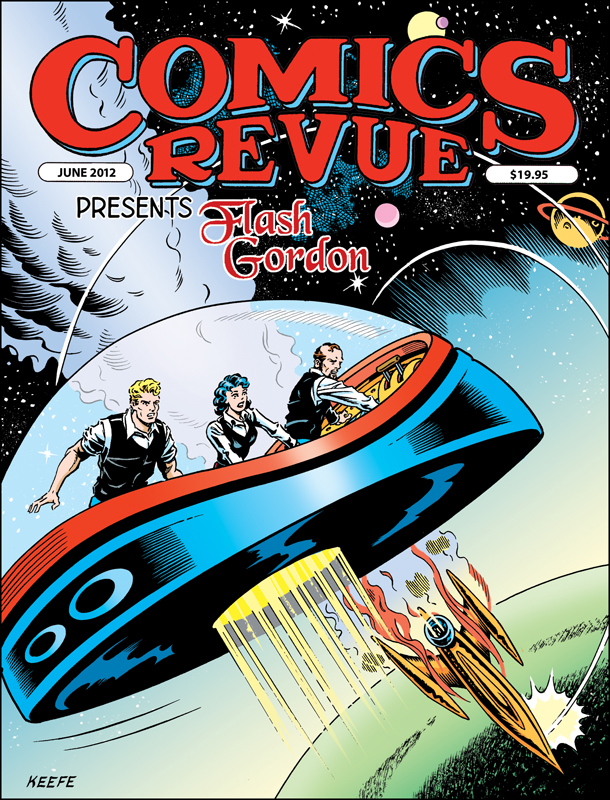
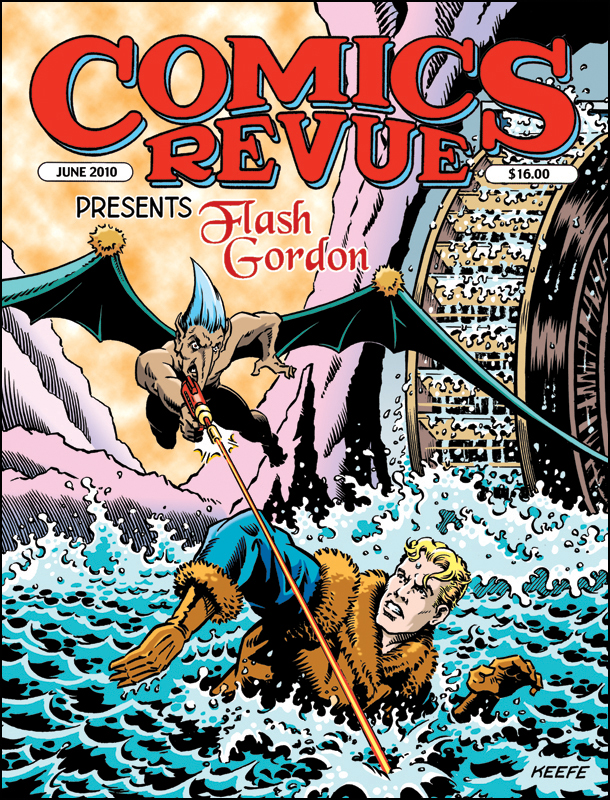
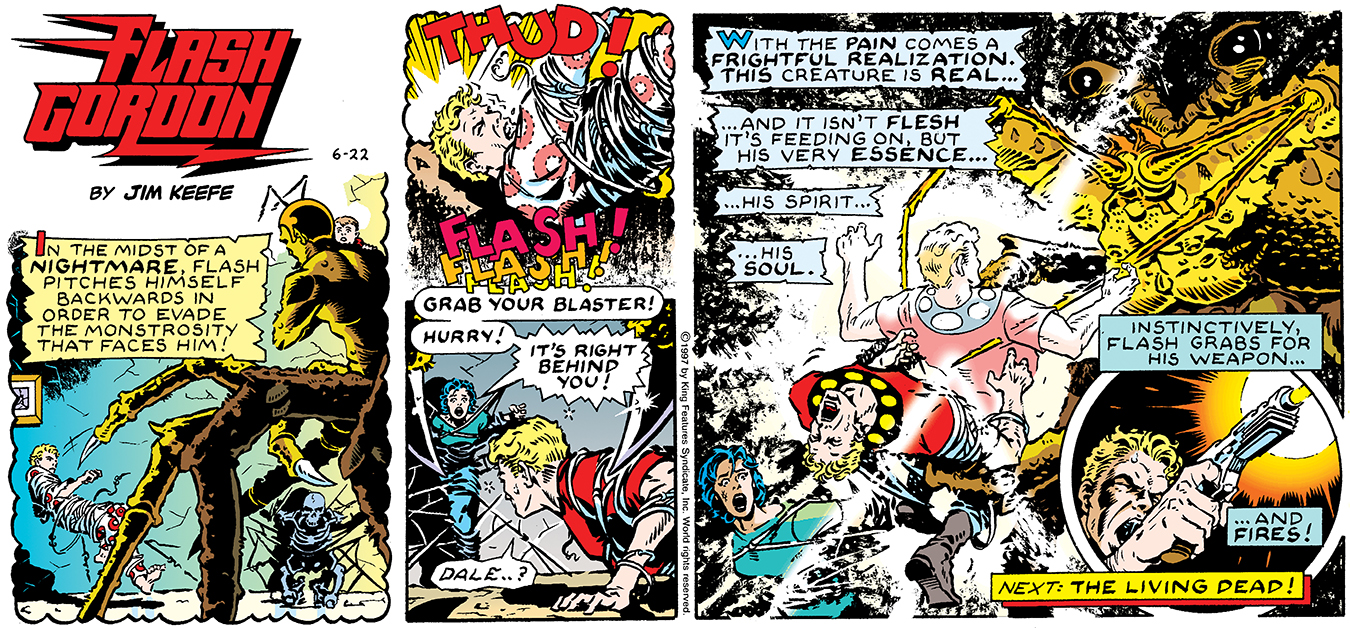
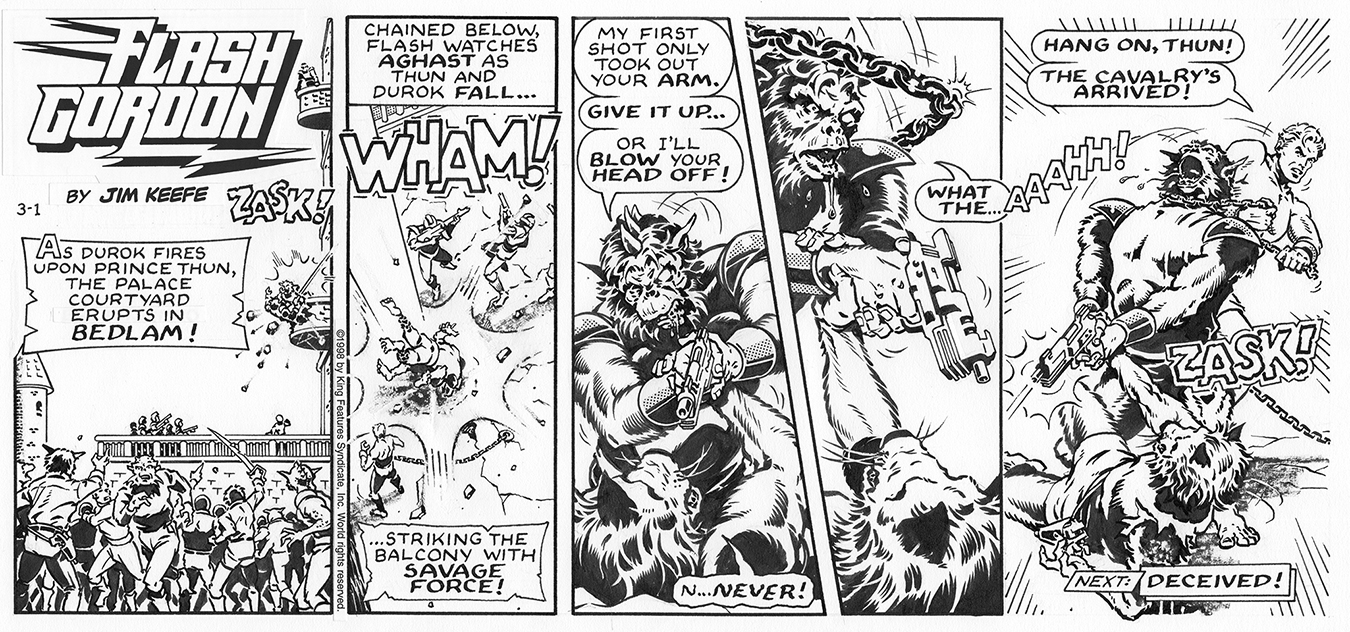
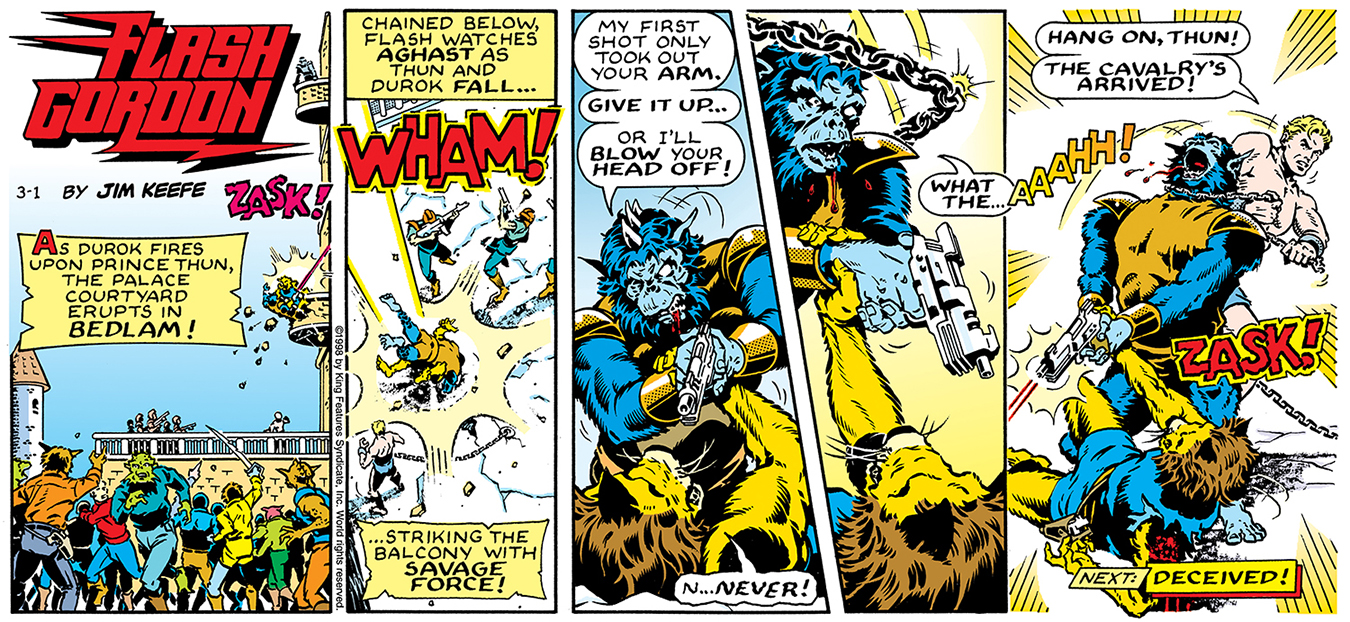
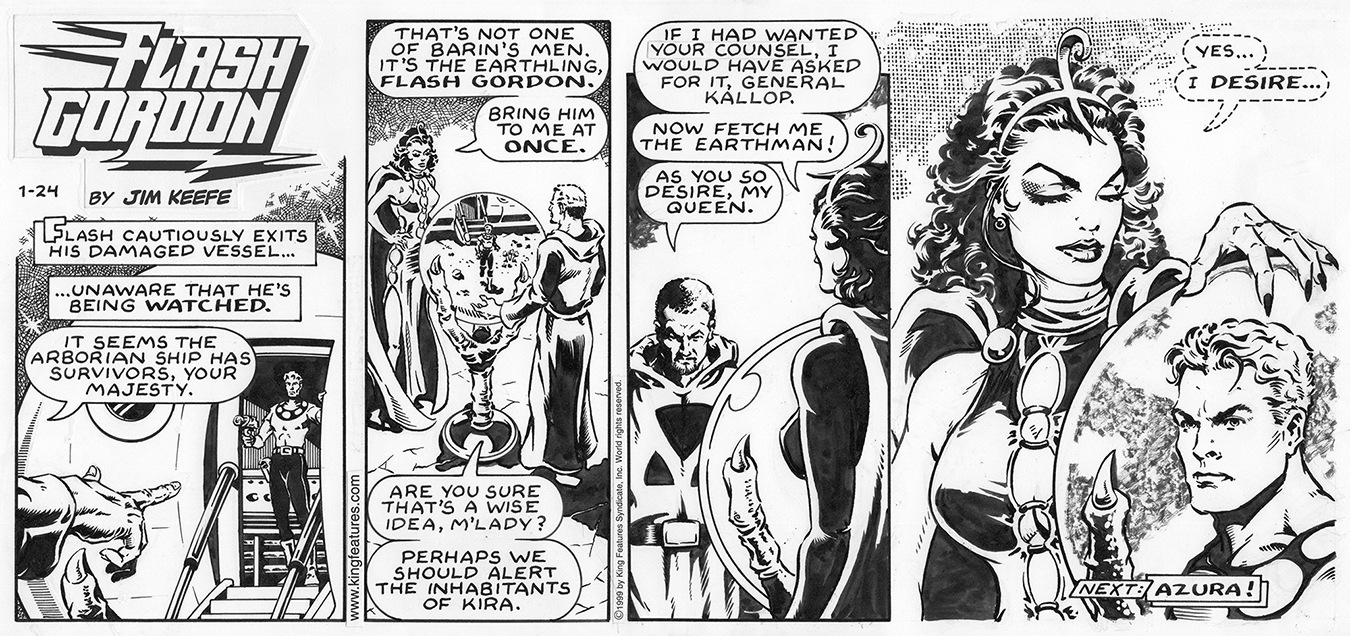
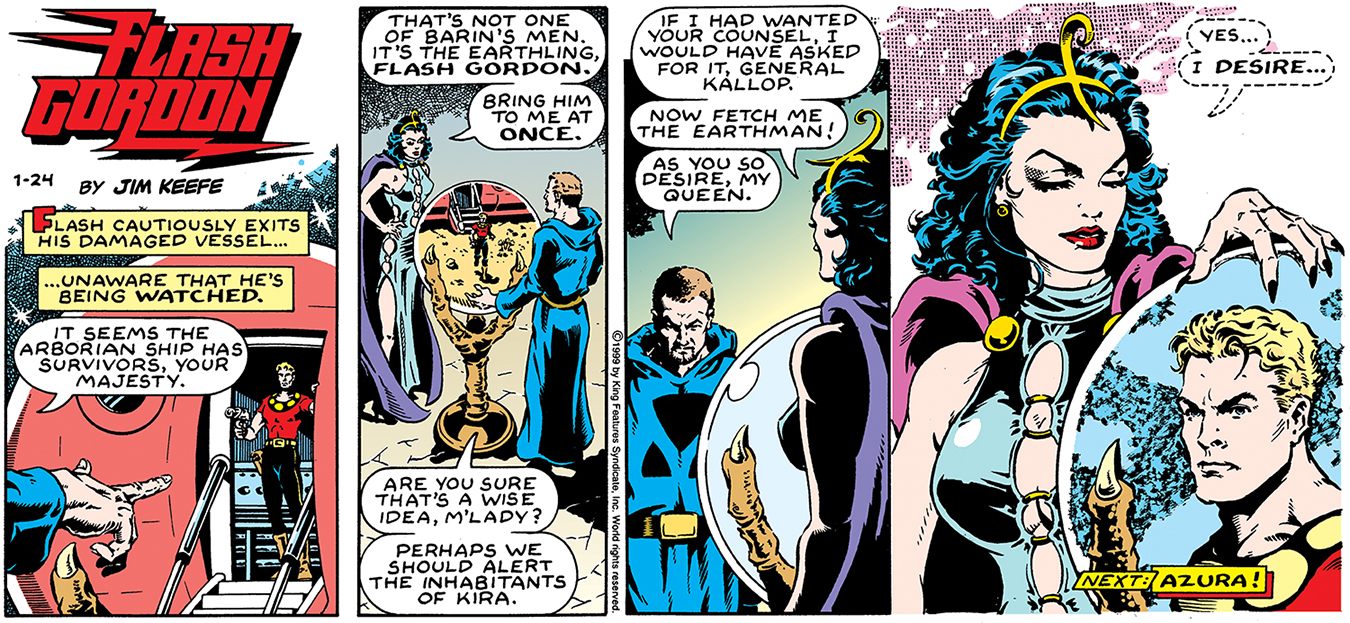
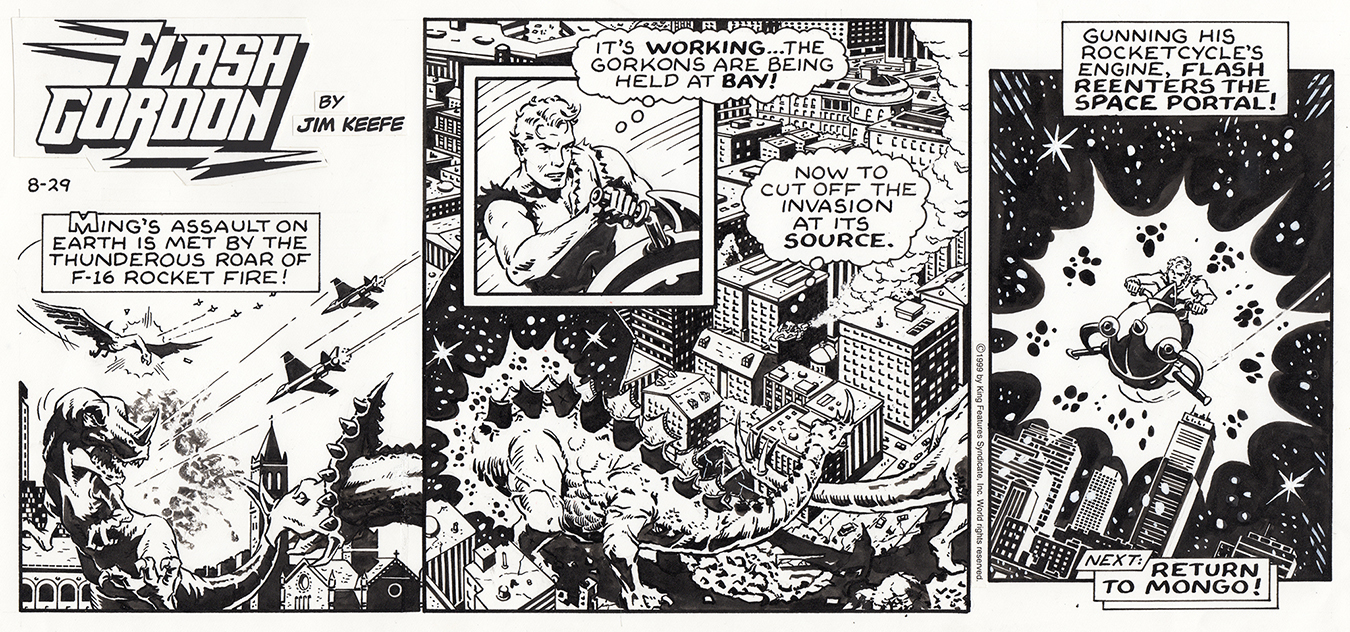
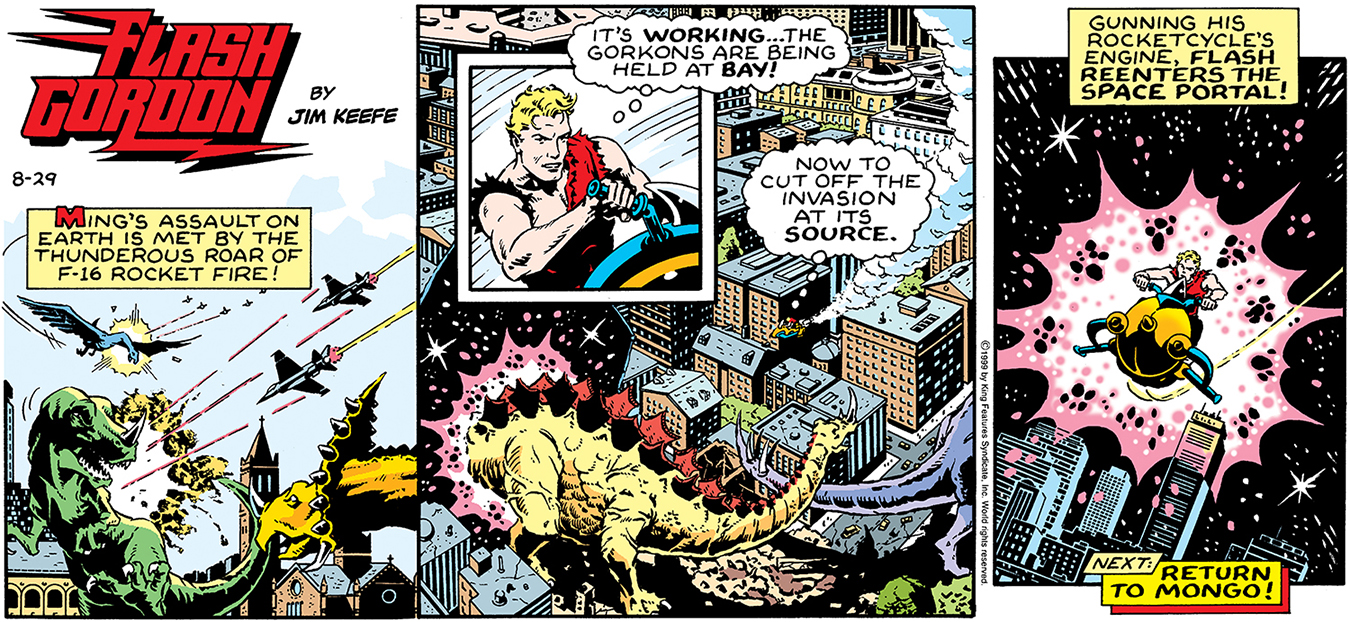
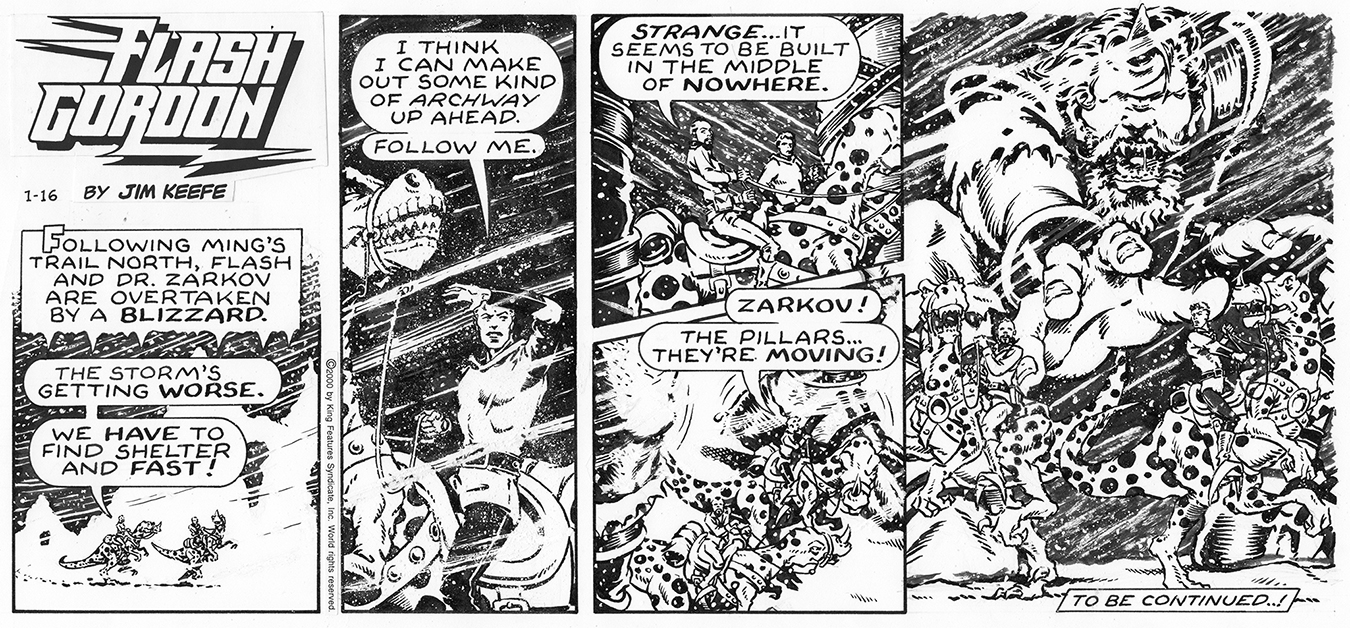
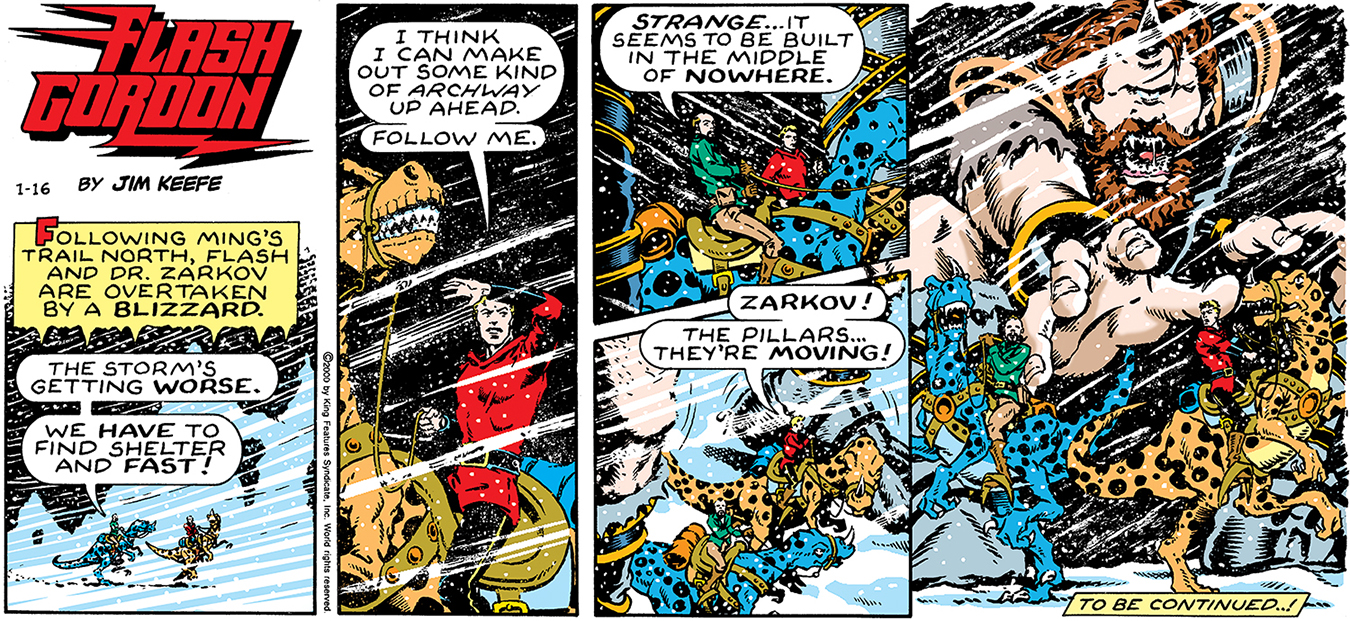
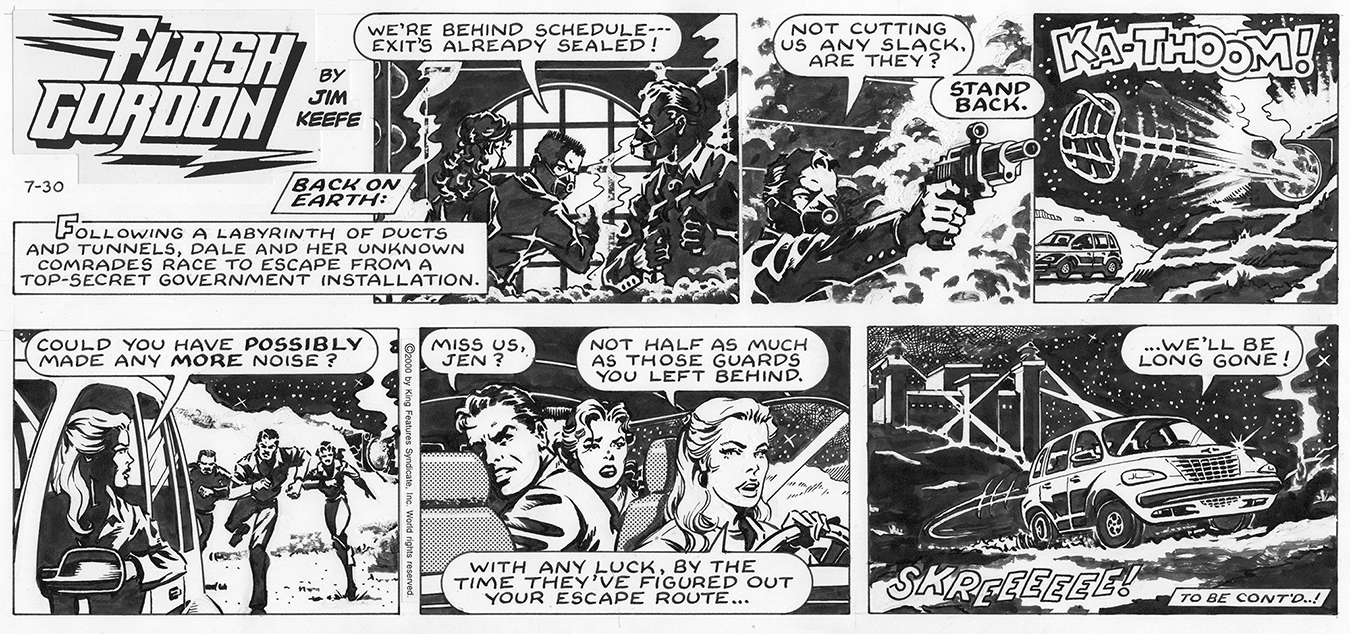
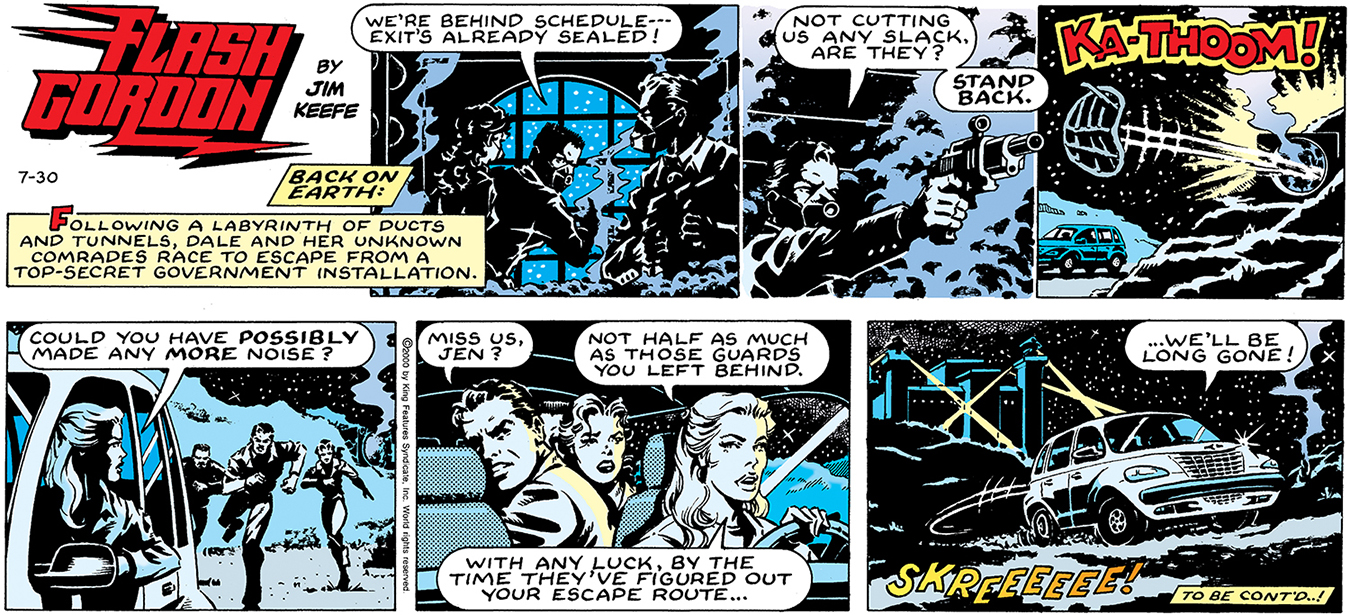
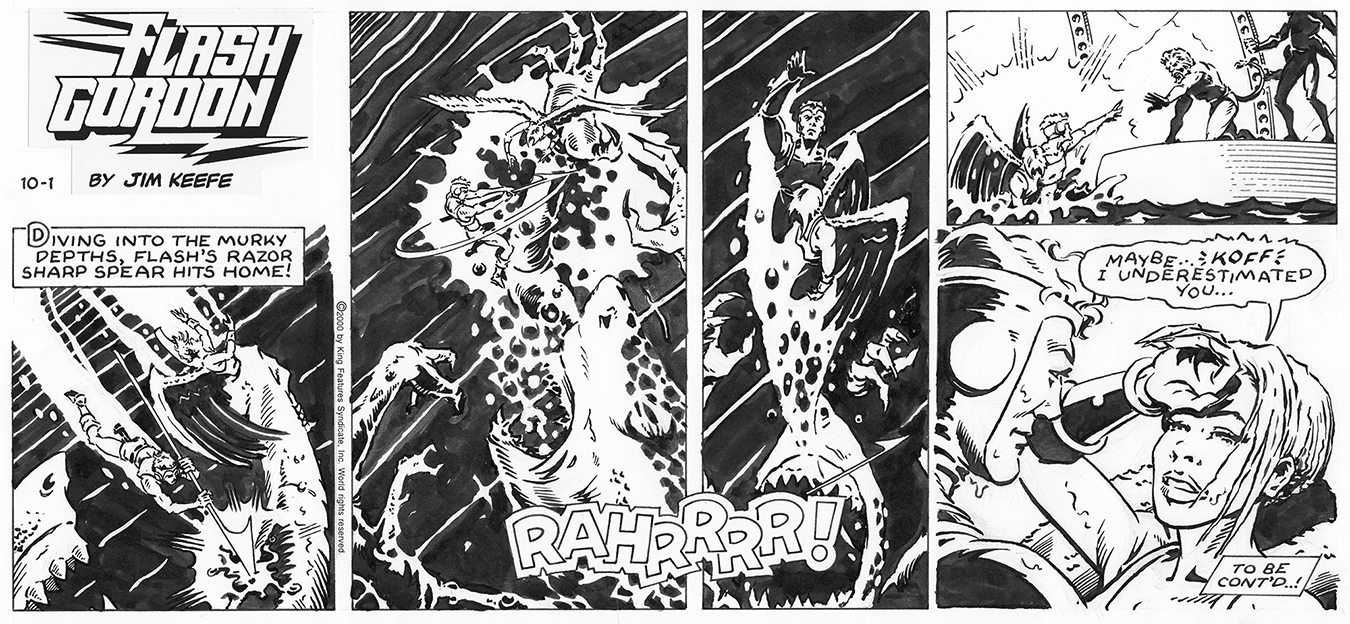
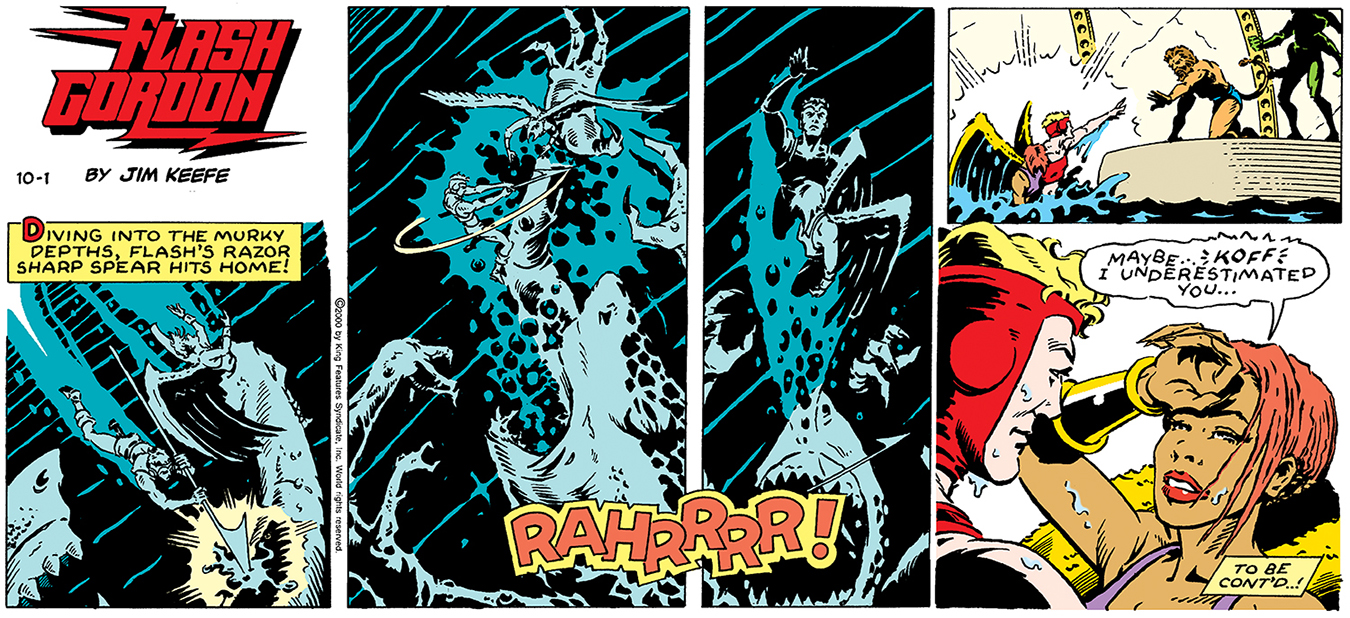
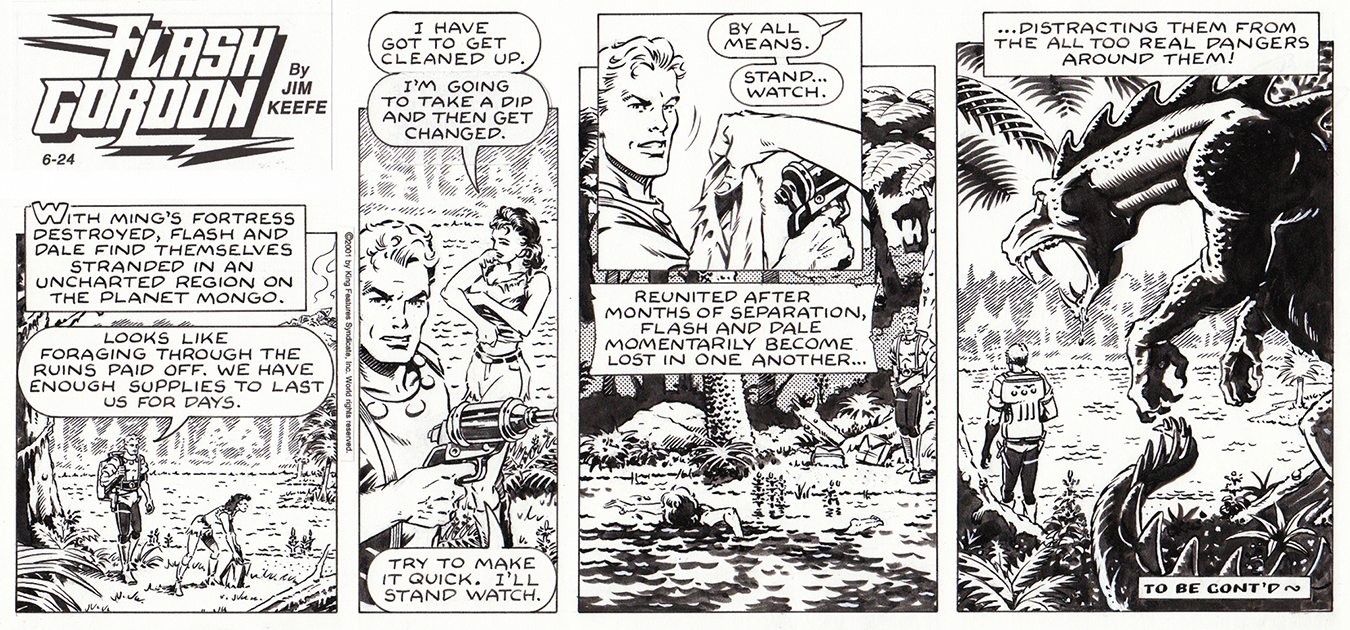
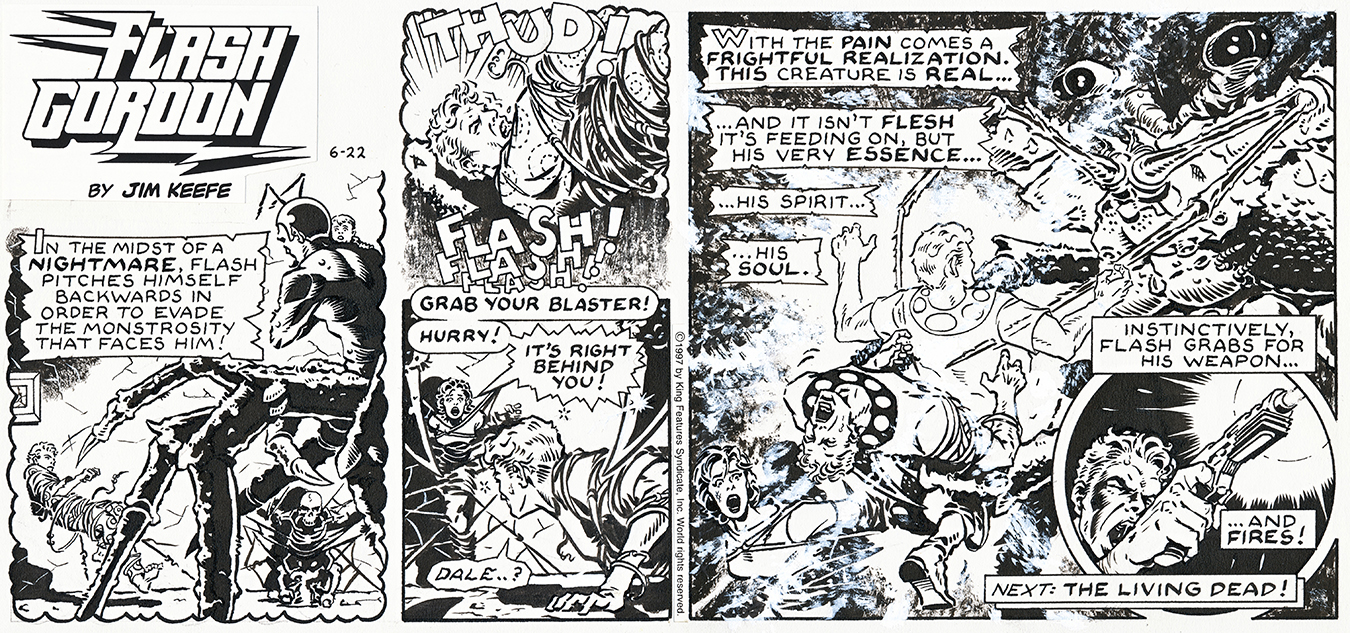
Flash Gordon Sunday pages
Written, drawn, hand lettered, and colored by Jim Keefe
Click on images to see larger.
Author: Jim
Jim Keefe is the current artist of the Sally Forth comic strip. From 1996-2003 he was the writer and artist of the Flash Gordon comic strip. A graduate of the Joe Kubert School, Keefe likewise teaches Comic Art. Teaching and speaking engagements include SVA in Manhattan, Hofstra’s UCCE Youth Programs, and most recently the Minneapolis College of Art and Design.
Flash Gordon Story Index

Flash Gordon by Jim Keefe
- 1. buy misoprostol cheap without perscription Demon From the Dark Dimension: 01/21/1996 – 4/21/1996
- 2. http://partnershipforcoastalwatersheds.org/?p=23641 Nightfall on Mongo: 4/28/1996 – 8/25/1996
- 3. The Way it Began: 9/1/1996 – 9/29/1996
- 4. The Return of Ming: 10/6/1996 – 12/22/1996
- 5. Durok’s Revenge: 12/29/1996 – 5/11/1997
- 6. Lair of the Damned: 5/18/1997 – 7/13/1997
- 7. Wartog: 7/20/1997 – 10/12/1997
- 8. Alania Under Siege: 10/19/1997 – 5/3/1998
- 9. Traitor In Our Midst: 5/10/1998 – 10/18/1998
- 10. The Way It Began: 10/25/1998 – 11/1/1998
(a condensed version of 9/8/1996 – 9/29/1996) - 11. Shadowland 11/8/1998 – 1/3/1999
- 12. Return To Syk: 1/10/1999 – 3/28/1999
- 13. Back to Earth: 4/4/1999 – 10/31/1999
- 14. Garden of Evil: 11/7/1999 – 12/19/1999
- 15. Gallery Page: 12/26/1999
(Spotlight of Flash Gordon artists throughout the years) - 16. The Way It Began: 1/2/2000 – 1/9/2000
(Reprinting 10/25/1998 – 11/1/1998) - 17. To Melt a Queen’s Heart: 1/16/2000 – 6/18/2000
- 18. Operation: Escape: 6/25/2000 – 8/6/2000
- 19. Peace Offering: 8/13/2000 – 11/5/2000
- 20. Secret Agent X-9: 11/12/2000 to 6/17/2001
- 21. Nesting Ground: 6/24/2001 – 8/12/2001
- 22. Flashback: 8/19/2001 – 10/28/2001
(In depth retelling of Flash’s origin story) - 23. Slithers: 11/4/2001 – 5/12/2002
- 24. Crowning Glory: 5/19/2002 – 8/18/2002
- 25. Hatchlings: 8/25/2002 – 9/22/2002
- 26. Tournament of Death: 9/29/2002 – 3/16/2003
Comic strips reigned supreme back in the 1930s. The Sunday sections were printed much larger than they are today and were a thing of beauty to behold.
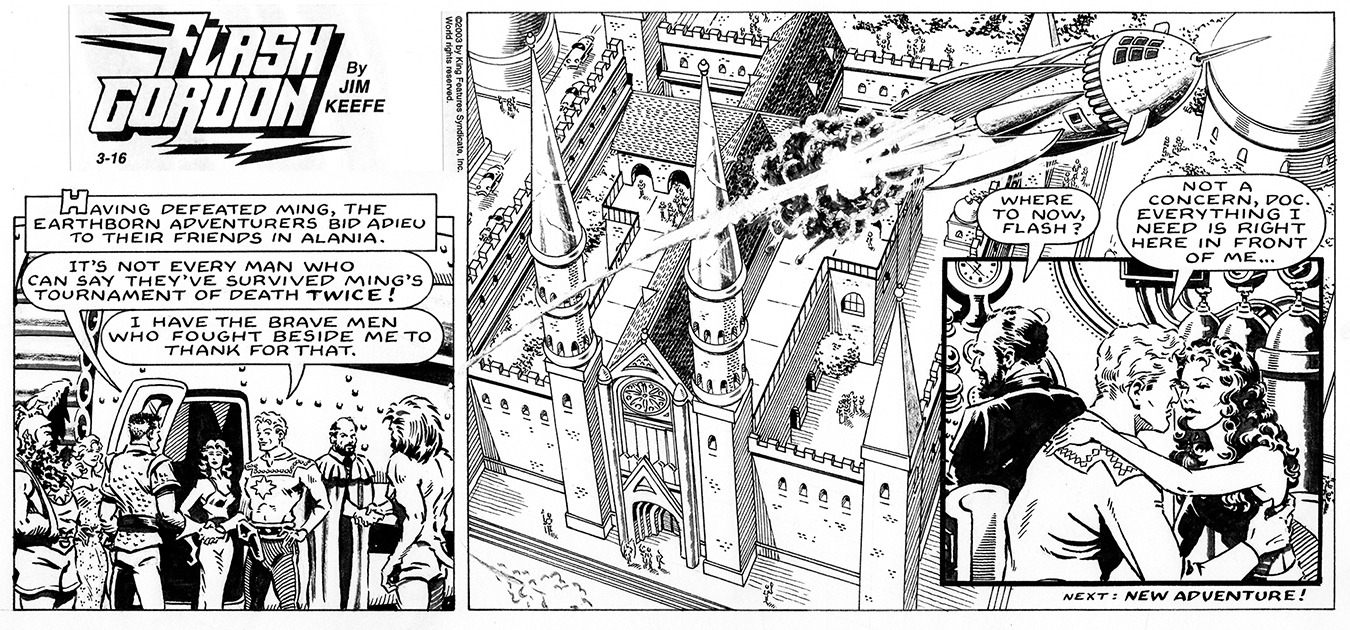
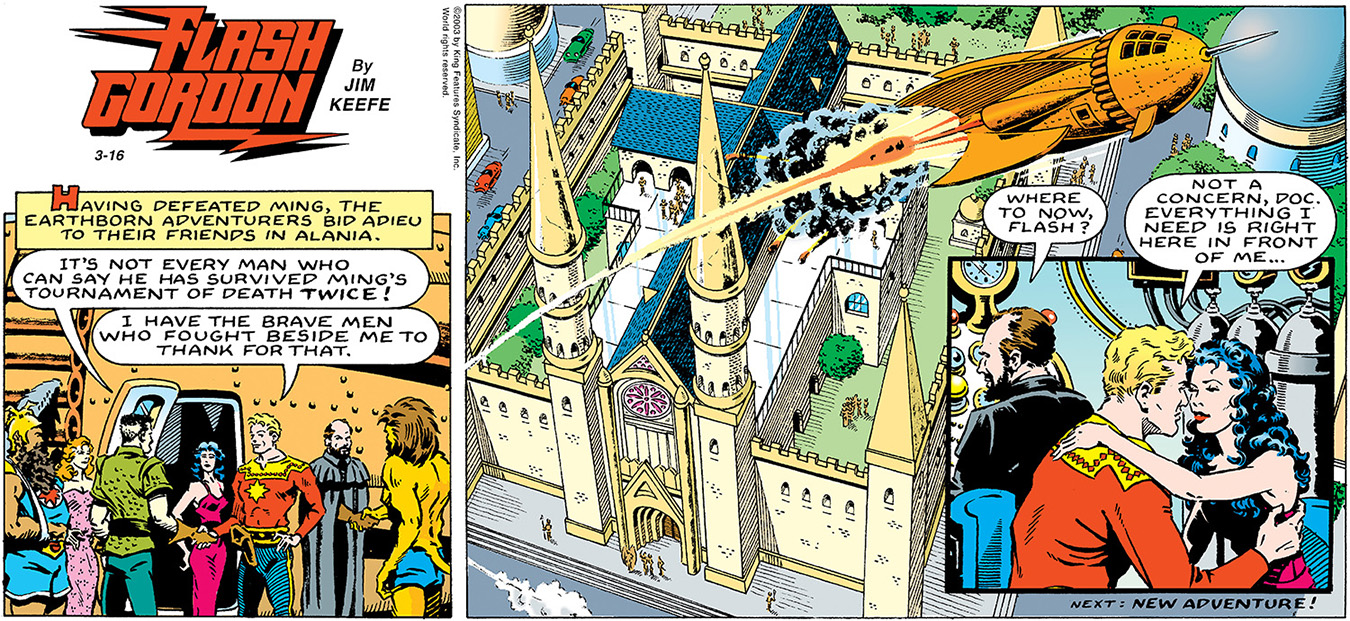
Adventure strips thrived during these years as there was room to tell a story. To see how much things have changed, just compare these two Sunday pages below from 1934 and 2002.

On the right – Flas
Jump ahead from 2002 to now and the comic strip Sunday pages have regrettably shrunken even smaller.
Here’s an example of my hometown paper the Star Tribune (my hand shown on the bottom left for scale). Unless you have a jewelers loupe you’re at a loss to see – much less read – what’s going on.

Here’s a comic page artist Terry Beatty (Ms. Tree, Rex Morgan M.D.) wrote and drew for Big Funny back in 2009 that really drives the point home.
Granted all is not doom and gloom – whereas comic strips in the newspaper may be on life support, we’re in a golden age as far as comic strip collections that are being published. Check out the Library of American Comics and Fantagraphics to name just a few.
I also feel like comic strips are being given a renewed life and readership online as fans of the medium now have the ability to binge weeks worth at a time. The big two comic strip sites being King Feature’s Comics Kingdom and AMU’s GoComics.
As times changes, so does the comics biz. Another example of this is that even though comic book sales have shrunk over the years, graphic novels have increased in popularity.
From an article in Publishers Weekly;
“Over the past five years, the North American graphic novel market has welcomed a wave of new readers and grown from about $805 million in sales in 2012 to more than $1 billion in 2017.”
From the Comics Beat;
“Overall, graphic novel sales in 2021 were up 65% from 2020…The growth was led by adult graphic novels, up 107%, but it’s important to note that this category includes manga which led the charge, up 17 million units.”
To sum up…
In the early 1900s onwards comic strips reigned supreme. By the 1940s comic books had taken off. In the 1960s indie comics/undergrounds entered the fray. In the 1980s self-published/alternative comics joined in at the same time graphic novels were just getting their sea legs. In the 1990s online content joined the mix. And now in the 21st century graphic novels and manga have taken flight.
And that’s not to say comic strips and comic books have been replaced and have gone away, it’s just that they aren’t the only game in town anymore.
Cartoons, comics, graphic novels – whatever you want to call it – the packaging keeps changing, but sequential art is just as popular now as it’s ever been. And as long as the stories are strong and the artwork delivers, the art form will continue to have an audience.
And that’s my two cents. See you in the funny papers…
-Jim Keefe

Coloring the Sunday Comics
From 1989-98 I was on staff at King as the head (and only) colorist for the King Features Comic Art Department. From 1999 on I did coloring for them freelance.
Pic from Funny Papers – Behind the Scenes of the Comics.
For my entire run coloring for King I worked “old school.”
Here’s the process…
King Features down in Florida does the color separations, so my job was to provide them with a color guide.
Here’s the color palette I used.
Using watercolor, I colored the black and white art and then put in the color indications using the numbers from the color palette. The actual watercolors didn’t have to be exact, that’s what the numbering was for.
And here’s what the finished version looked like.
It’s a very conscious decision to keep the coloring simple and not over render so the color is not competing with the clean line of the artwork. Here’s some more examples of my work…

And as of November of 2021, a little over 30 years total, I’m calling it a day. It’s been a good run, but time commitments with my current work schedule just made it impossible to continue.
Wrapping up with a pic the great Dick Hodgins Jr. (1931-2016) sent me awhile back. Something I’ll always treasure.

Copy that went with the photo shown above:
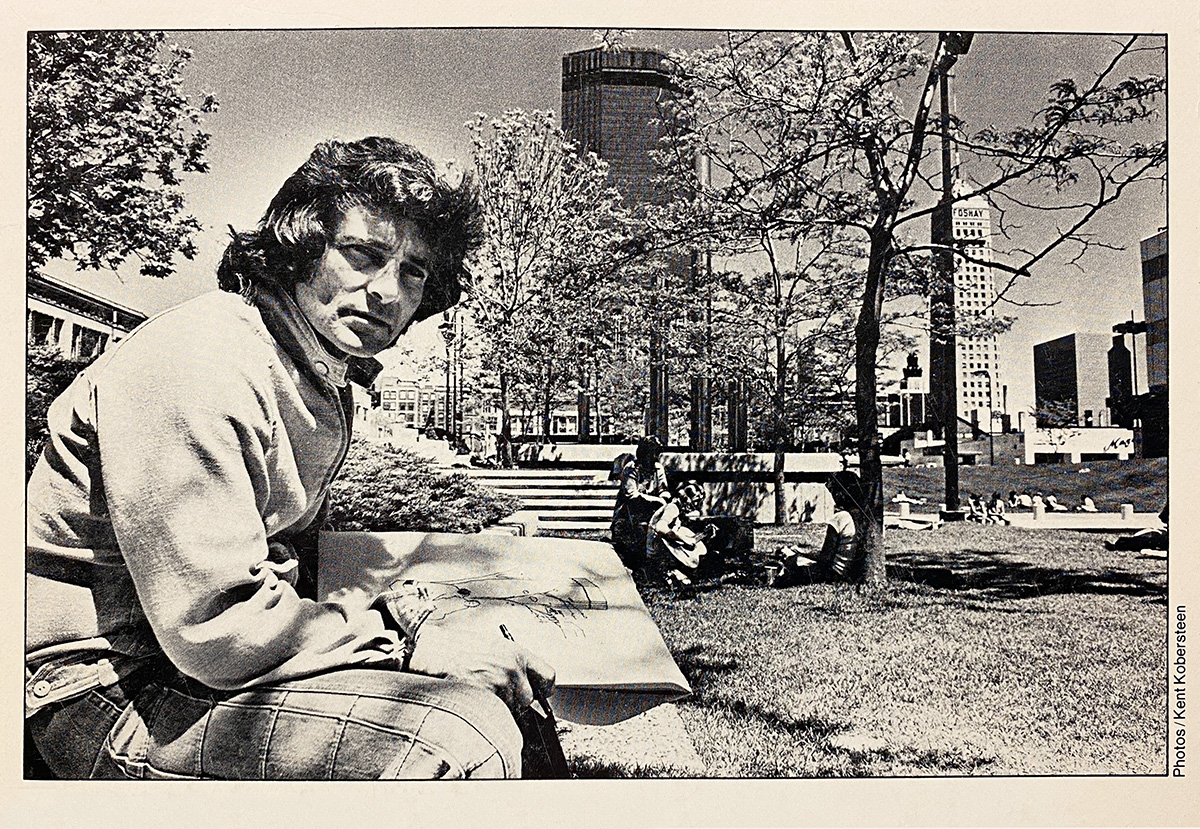
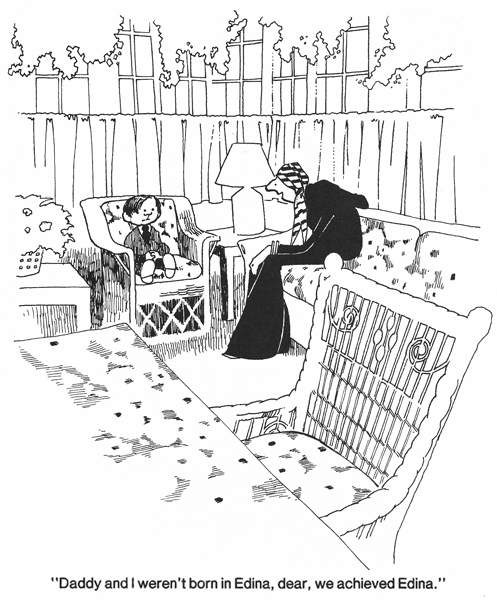
“Dick Guindon’s first cartoons, dealing with a character called Hugger Mugger, were published in the Minnesota Daily. Hugger Mugger eventually was syndicated and appeared in 100 college newspapers. Guindon then went to New York, where, as a freelance cartoonist, he sold his work to Downbeat, Playboy, Esquire and New York Magazine. The Realist sent him abroad for a year as a kind of cartoonist-correspondent in Greece, Turkey, Egypt, Jordan and Israel. Guindon was born December 2, 1935, in St. Paul. He began cartooning when he finished three years in the army, and he joined the Minneapolis Tribune in 1968.”
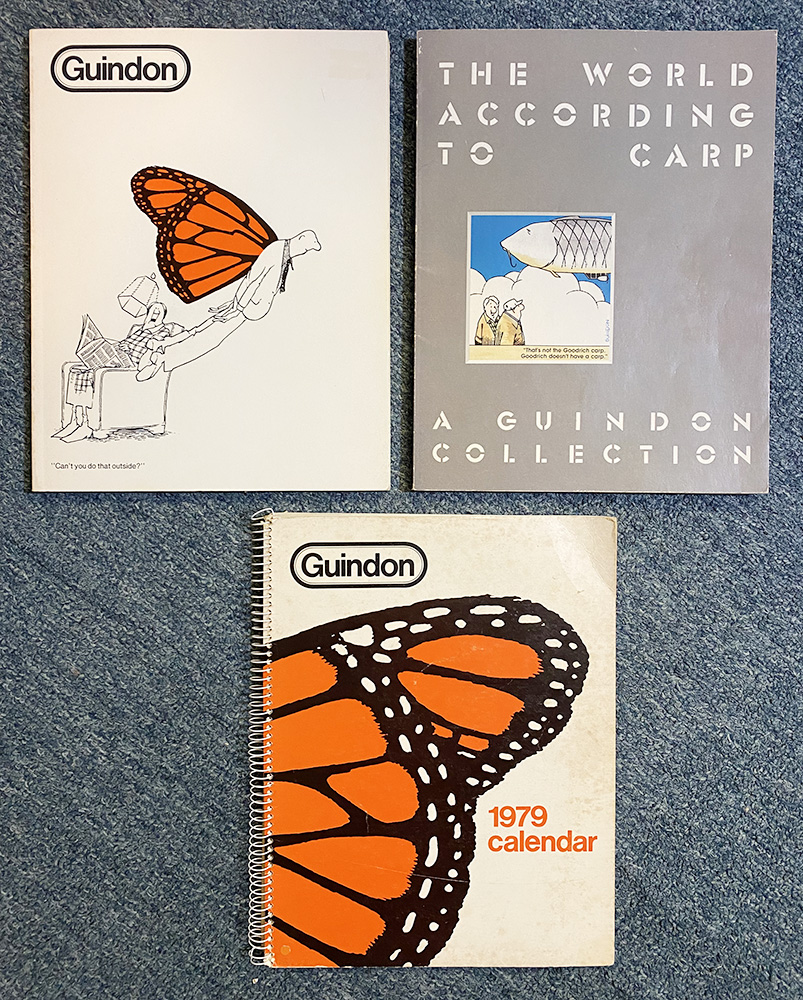
Guindon in his own words from the foreword…
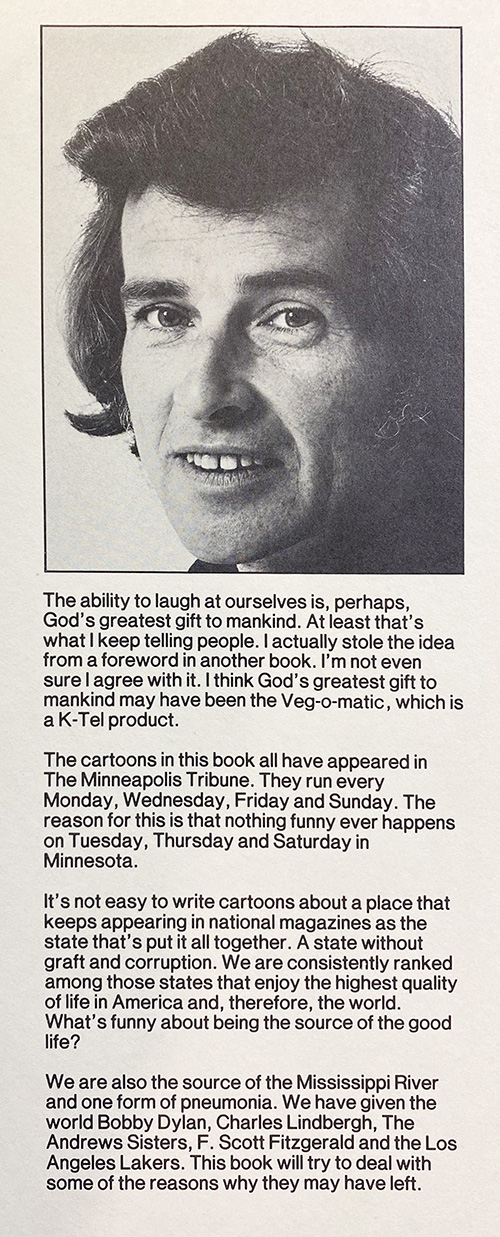
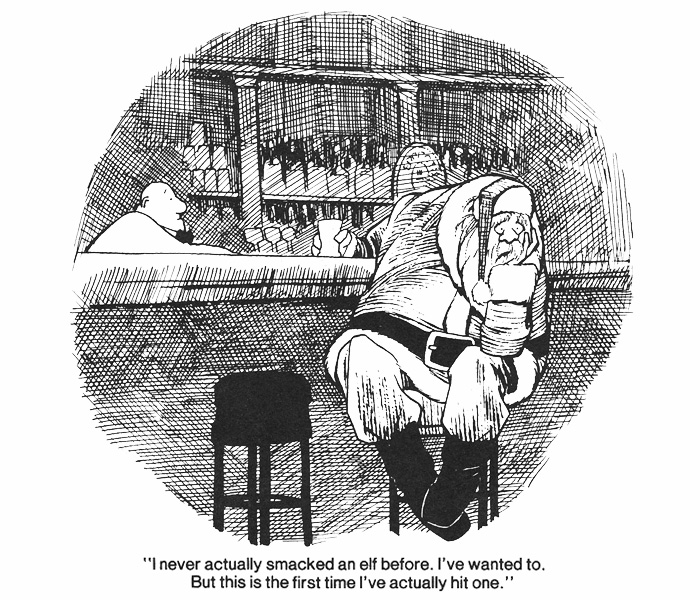
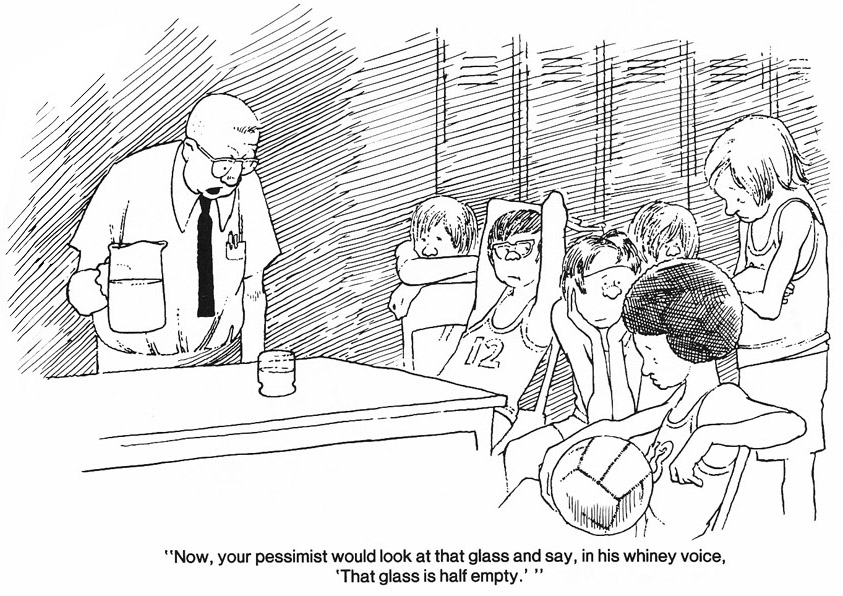
I grew up on Guindon – he was one of my favorites. His cartoons nailed the archetypal Minnesotan in a way that no one else has come close. The caricatures in the Coen brothers movie Fargo are the popular stereotype, but Guindon went more to the core.
In 1981 Guindon moved from Minneapolis to Detroit. YouTube has the following time capsule of the event. There are quick cameos of a young Louie Anderson and Garrison Keillor among others…
And here’s an interview with Guindon in Detroit.
Tragedy struck in April 1987 when the studio Guindon had in a historic four-story building in Traverse City, Michigan was destroyed by fire. More than 5,000 cartoons and sketches burned.
In February 2005 Patty Stearns interviewed Guindon for Traverse Magazine. Here’s some excerpts…
Gaze over to the floor-to-ceiling bookcases in
Guindon’s living/dining room and scan the titles: The
Catcher in the Rye, Marcella’s Italian Kitchen, Salt: A
World History, The Lies of George W. Bush. There’s an
entire section devoted to the works of novelist Elmore
“Dutch” Leonard, whose late wife, Carol, brought back
one of Guindon’s prized espresso pots from a trip to
Europe. A case of the cartoonist’s favorite wine,
Côtes du Rhône, fills another couple of shelves.
Next to that stands a three-quarter-sized rendition
of the artist himself—a painted board with a cutout
for a wristwatch, which is missing. Guindon calls
it his “Grandfather Clock,” although he is not yet
a grandfather.
Guindon has produced cartoons that are part of the Smithsonian
Institution’s Archives of American Art and The Ohio
State University Cartoon Research Library. He has authored
six books, and collectors sell pieces of his life from galleries and
over the Internet for big bucks.
None of this has gone to his head.
Guindon has never socialized much with his fellow cartoonists.
“I find them a little bit sad, frankly,” he says. “They
tend to work on kitchen tables and not think of themselves
very professionally and that sort of thing.” He gets a smirk on
his face.
You never really know when he’s kidding.
“Everyone who’s ever been around me is always surprised by
how much goes into it, because you always think, well, they’re
just potato heads,” Guindon says.
But screenwriter Kurt Luedtke, a friend and former executive
editor of the Free Press, has seen this artist in action.
“The truth about Guindon is that he draws unusually well; a
lot of folks miss that, I think, perceiving him as a very funny
guy with an offbeat sense of humor who’s a cartoonist. Study
those panels for a while and you realize that his oblique take
on life is just the beginning of a process that really ends with
a masterful pen.”
According to Wikipedia, Guindon announced his retirement the same year as the preceding interview – 2005.
The Detroit Free Press reported that Richard Gordon Guindon, 86, died the evening of Feb. 27, 2022 in Northport, Michigan, after a long illness with his son at his side.
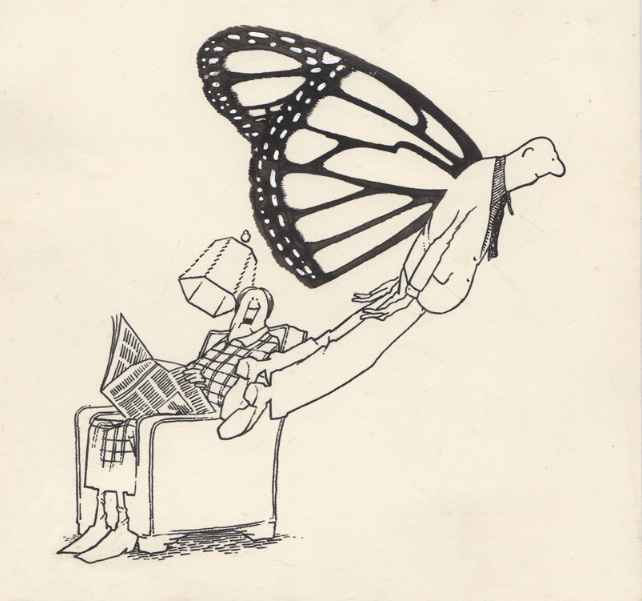
You can check out more of Guindon’s work at
The Billy Ireland Cartoon Library & Museum Blog.