Frank Mucedola (1921-2007) served as a Tech Sergeant in I-304-76. A musician in civilian life, he established the Frank Mucedola Accordian School in Auburn, New York and has toured with the world-renowned Mantovani Orchestra.
The following article originally ran in The Auburn Citizen August 24, 2003
The 76th Infantry Division received its “Baptism of Fire” during the battle of the Bulge.
After crossing into Germany from Belgium and Luxembourg, the division was the spearhead of General George S. Patton’s 3rd Army final drive across central Germany and were among the first troops to make contact with the Soviet Red Army in the vicinity of Chemnitz, Germany, in May 1945.
The 76th Division had gone further east into Germany than any other American unit.
When Germany was divided into East and West, the 76th Division found itself in the East and was subsequently pulled back into the Western Zone.
However, between May and August 1945, when the Russians arrived, the 76th Division was on occupation duty in Schmolln, Thuringen, Germany.
From August 1945 until the Berlin wall fell, schools in occupied East Germany were required to teach students that Germany had been liberated from the Nazis by “The Glorious Red Army.”
The pre-1945 generation knew better, but kept silent out of fear of reprisals.
When the 76th Division was relieved of its occupation duties in August 1945, it was deactivated and its troops were reassigned to other units slated for the invasion of Japan which, for a brief time, was still at war with the United States.
Fortunately, that assignment never materialized as the atomic bomb ended the war and the troops were sent home.
Many years later, after the fall of the Berlin Wall, the people of Schmolln in the former East Germany wanted to correct what they knew was a historical lie. They were not liberated from the Nazis by the Soviet Army, but by the 76th Infantry Division of the United States Army.
On April 13, 2003, the people of Schmolln erected a memorial to the 76th Division to show their appreciation.
I am one of the nine Auburnians who served in the 76th Infantry Division during World War II and am grateful that the people of Schmolln have honored us with their thoughtfulness.
-Frank Mucedola
Auburnians who served in the 76th Division in WWII
George P. Diehl Paul J. DiFabion Ronald P. Hart Robert T. Mott Frank Mucedola James Napoli George T Ryan James Smith Paul A. Tripociano
Pictures from a 2003 Veterans Tour that included Schmölln.
Veterans of the 76th Division @2003 Anne Adams
@2003 Charles Themar
Inscription on plaque:
THIS PLAQUE RESPECTFULLY PRESENTED TO THE PEOPLE OF SCHMOLLN, THURINGEN, GERMANY BY THE 76TH INFANTRY DIVISION AND COMPANY I, 304TH INFANTRY REGIMENT UNITED STATES ARMY WHO SERVED IN THIS CITY FROM MAY TO JULY 1945 “THANK YOU FOR REMEMBERING US” 76TH INFANTRY DIVISION ASSOCIATION APRIL 13, 2003
Postscript
Dave Keefe
In 2010 David Keefe, a US Marine and grandson to Richard Keefe (I-304-76), visited Schmölln to honor his Grandfather’s service in the War and to see the plaque firsthand. Here’s the video he took.
This web page is dedicated to my Dad, Richard Keefe, and all the men who served with him in the 76th Infantry Division.
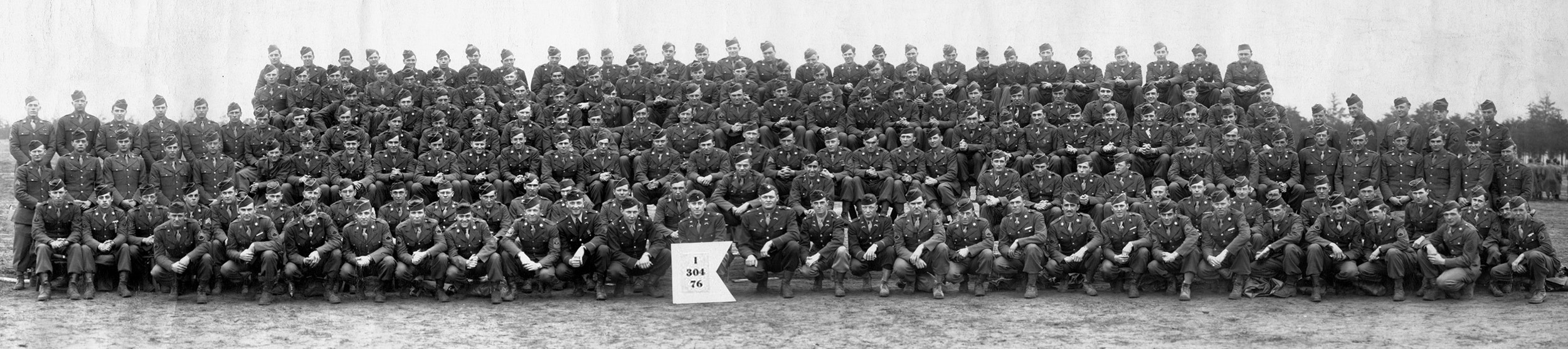
Company I 304th Infantry Regiment 76th Infantry Division
Camp McCoy, Wisconsin – November 1944 Photo courtesy of Jay Hamilton LTC USA (1921-2008)
Click on the image to see larger.
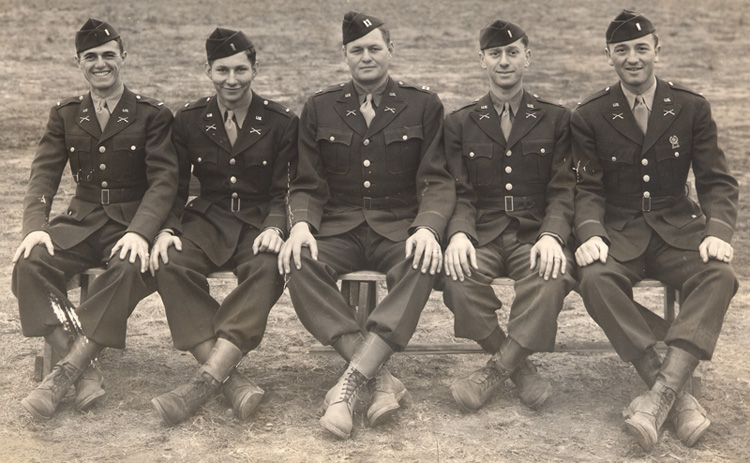
The Commissioned Officers of Company I. This picture was taken at Camp McCoy, Wisconsin in November of 1944.
(Left to Right) 2nd Lieutenant Steve Galanas, 2nd Lieutenant Richard Keefe, Captain Don Rue Hickman, 1st Lieutenant Donald Katz, 2nd Lieutenant Jay Hamilton
The following pictures were taken May of 1945, after V-E Day, while occupying the town of Schmölln, Germany.
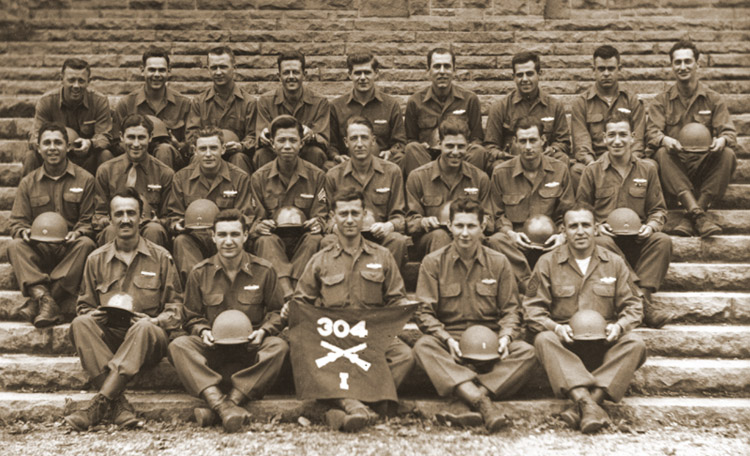
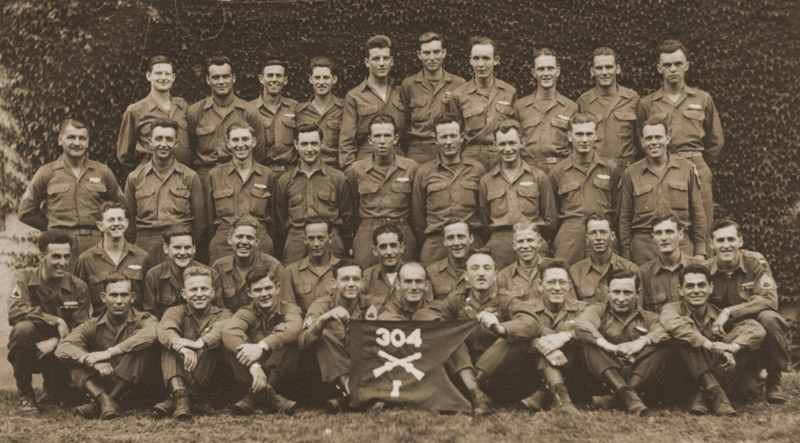
Company Headquarter – May 1945
First Row – Bottom: S/Sgt. Lo Russo, 2nd Lt. William Richard, Capt. Donald Katz, 1st Lt. Richard Keefe, 1st Sgt. Anthony Fackelmann
Second Row: T/5 Raymond Martinez, Pfc. William Bankston, Sr., Pfc. Harold Suesse, T/4 Fong Him, Pfc. Marvin Trammel, Pfc. Jean Stephens, Pfc. Kenneth Hague, Pfc. Milton Schwartz
Third Row: Pfc. George Mortimer, Cpl. Earl Annis, Pfc. William Hedden, Pfc. Olland Seymour, Pfc. Thomas Geary, T/5 Malvin Leykauf, T/5 Philip Karas, Pfc. Elbert Dove, Pfc. Bernard Rosenburg
Not Pictured: T/5 James Bailey, Pfc. Tim Brooks, Pvt. Karl Cunningham, Pfc. Cleon Duke, Pfc. Frederick Echsner, Pfc. Fred Ethington, Sgt. Harvey Fowler, Pvt. Richard Gardner, S/Sgt. Philip Gillis, T/5 Anthony Grunder, Sgt. Donald Hawley, 1st Lt. Edward Hurley, Pfc. William Jones, Pfc. Ralph Kierski, Sgt. Jay Lachot, Pfc. Morris Levy, T/5 George Livernois, T/5 John Macomber, T/5 Lucien Nadeau, Pfc. Abel Parks, Pfc. Raymond Radtke, Pfc. Jack Sapoznik, Pfc. Elmer Slate, Pfc. James Thomson
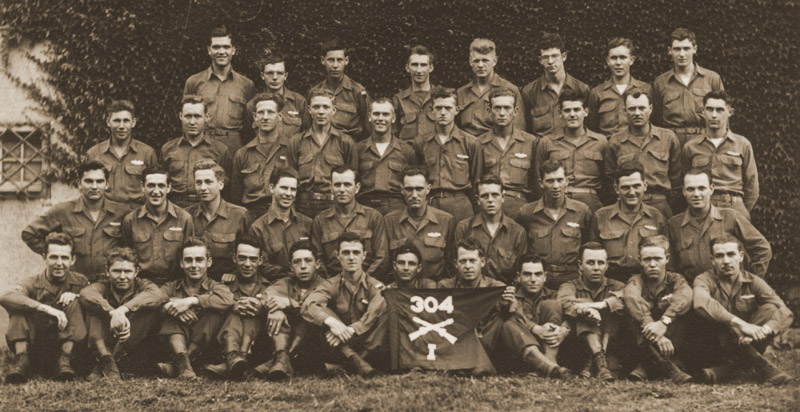
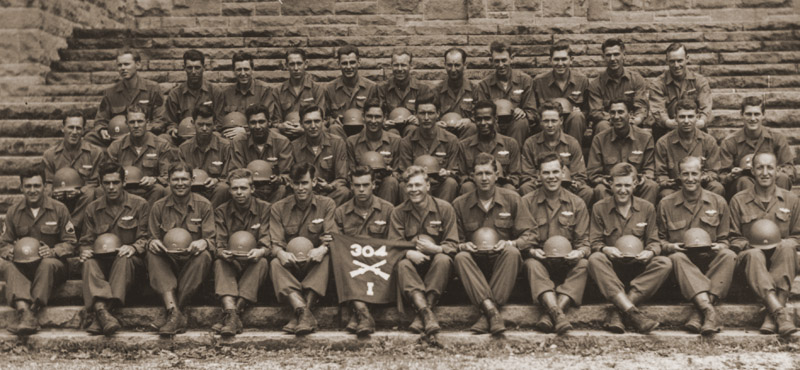
First Platoon – May 1945
First Row – Bottom: S/Sgt. John Beardsmore, Pfc. Joseph Kopper, Pfc. Lester Ward, Pfc. Howard Kelly, Pfc. John Neggia, ist Lt. Steve Galanes, Pfc. Tobias Gutierrez, T/5 Kermon Silver, Pfc. Julius Yellen, Pfc. James Quinn, Pfc. Arvel Rice, Pfc. Leroy Gansereit
Second Row: Sgt. Paul Kmett, Pfc. Lester Isaacs, Pfc. Robert Leonard, Pfc. Wilburn Rundle, T/5 Lawrence Beasley, Pfc. John Bozich, Pfc. Leonard Watson, Pfc. Douglas Johnson, Pfc. Edward Algas, T/5 Wallace Maze
Third Row: Pfc. Lloyd Brink, Pfc. Calvin Belue, Pfc. Richard Doucett, Pfc. Guy Stump Jr, Pfc. Richard Pfeiffer, Pfc. Ulysses Rogers Jr, Pfc. Joseph Kudyba, Pfc. Ernest Kaszian, Sgt. Zack Parsons, Pfc. Paul Henzarek
Fourth Row: S/Sgt. James Harris, S/Sgt. Sigmund Romanowski, Pfc. Joseph Todd Jr, S/Sgt. Thomas Rogers, Sgt. George Bailie, Pvt. Bobby Booz, Pfc. Carl Tillman, Pfc. John Pajor
Not Pictured: Sgt. Frank Favata, T/Sgt. Bernard Kelleher Jr, Cpl. Edwin Palmquist
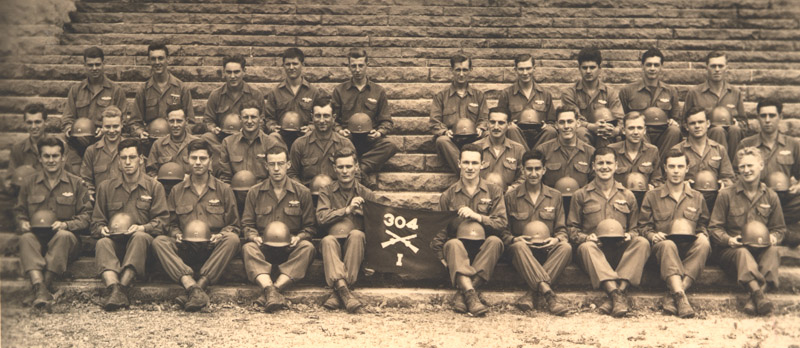
Second Platoon – May 1945
First Row – Bottom: Pfc. Joseph Caroll, Pfc. Wayne Thompson, Pfc. George Blount, S/Sgt. Joseph Zellner, Sgt. Arthur Martinez, 2nd Lt. Jay Hamilton, S/Sgt. Palmer Kittelson, Pfc. Frederick Rosenberry, Pfc. Raymond Gold
Second Row: S/Sgt. Wilson Thompson, Pfc. Charles Simmons, Pfc. Mark Tomasek, Pfc. Martin Silverman, Pvt. Kenneth Beckman, Pvt. Samuel Morbit, Pfc. Carl Canterbury, Pfc. John Needum, Pvt. Charles Banks Jr, Pfc. Lorel Roestel, S/Sgt. Roland Dubois
Third Row: Sgt. Michael Sapalik Jr, Pfc. James Wood, Pfc. Ernest Lege, Pfc. Alphie Gagnon, Pfc. Peter Motherway, Pfc. Clarence Hornsby, Pfc. Jack Adams, Cpl. Bernard Rish, T/5 Robert Laselle
Fourth Row: Cpl. Charles Hawk, Pfc. Larry Gleaton, Pfc. Johnny Cochran, Pfc. Jack Burns, Pvt. Martin Gorneault Jr, Pfc. Curtis Fellure, Pfc. Hugh Maguire, Pfc. John Odgers Jr. Pfc. Harry Paff, Pvt. George Bergen
Not Pictured: Pvt. Herman Hahler, Pvt. Kenneth Obrecht, 2nd Lt. Charles Sands III, Pfc. Francis Schott, T/5 Olvin Stephens, Pvt. Albert Sutton
Third Platoon – May 1945
First Row – Bottom: S/Sgt. Silvio Zinicola, S/Sgt. Anthont DiMare, Pfc. Jesse Slovacek, Pfc. George Bowden, Pfc. Paul Sanderson, Pfc. Wayne Hardy, Pvt. Alphie Leblond, Pfc. Robert Wendell, Pfc. Leo Goldenstein, Pfc. R. G. Johnston, Pfc. William Norford, Sgt. James Mulligan
Second Row: S/Sgt. Walter Williams, S/Sgt. James Cotton, Pfc. Kenneth Morgan, Pfc. Salvador Vasquez, Pfc. Henry Kopinski, Pfc. Glendon McGee, Pfc. William Bowles, Pfc. Manuel Rivera, Pfc. Lewis Maker, Pfc. Thomas Fichera, Cpl. Joseph Grasso, Pfc. Donald Trexler
Third Row: S/Sgt. George Hatcher, Pfc. Harold Sharp, Pfc. James Turner, Pfc. Clarence Deaton, Pfc. Woodrow Dunn, Cpl. Arthur Carlson, T/4 Robert Steiger, Pvt. Clifford Dilla, Pfc. Curtis Spencer, Pvt. Donald Howland, Sgt. Verner Drake
Not Pictured: Pfc. Frank Ceniceros, Pvt. Marvin Gerstin, Pfc, Pedro Lopez, T/Sgt. Frank Mucedola, Pfc. Ashel Shults Jr, Pfc. Eugene Tortolano
Weapons Platoon – May 1945
First Row – Bottom: Sgt. Theodore Pleasants, Pfc. Richard Cook, Pfc. Edward Borgoyn, Pvt. Charles Pawlowski, Pfc. Malcolm Kerr, Sgt. Eugene Sharp, Pfc. Myron Chaderjian, Pfc. William Brockerman, Pfc. Frederick Hannon, /Sgt. William Neil
Second Row: Sgt. Donald Pessimier, Pfc. Ted Cook, Pfc. Ben Hensley, Pvt. Alfred Gwara, Pfc. George Kline, Cpl. Irwin Cohen, T/5 Samuel Jones, Pfc. Jesse Addington, Pfc. William Davis, Pfc. Donald Hepfer
Third Row: Sgt. John Scott Jr, Pfc. Norman Alderman, Pfc. Wesley Simmons, Pfc. Norman White, Pfc. Keith Hier, Cpl. Howard Landefeld, Pfc. Richard Hooley, Pfc. John Jardini, Pfc. Dale Roth, Pfc. Frederick Stefansen
Not Pictured: 1st Lt. Robert Conrad, S/Sgt. Charles Miller, Sgt. Ernest Wagganer
The following video includes pictures of my Dad’s, pics from Don Katz and also Jay Hamilton.
Unless otherwise specified, the preceding pictures are courtesy of Don Katz. Don Katz began with I-304-76 as a First Lieutenant. By the war’s end he would be Captain of Company I.
I would like to thank Don Katz and the following veterans who have graciously assisted me in my research.
Jay Hamilton Don Rue Hickman Lester Isaacs Sam Jones Frank Mucedola John Neggia
If interested to see the catalyst for how this research and web page came together, check out: Company I – Patreon
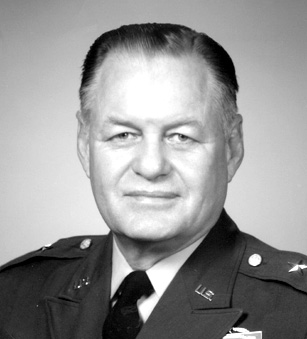
Brig. Gen. Don Rue Hickman was the original Captain of I-304-76. He’s the Captain they trained with at Camp McCoy before going overseas, and the Captain they first saw battle with going into the Siegfried Line in February of 1945. In March of 1945 Hickman would be transferred up to the 304th Battalion to be replaced as Captain of Company I by then Lt. Donald Katz (who would be promoted to Captain).
The following article appeared in Utah’s Daily Herald September 28, 2005 in honor of Don Rue Hickman after his death.
General Loses Battle With Cancer, Declines Arlington by Heidi Toth
Retired Brig. Gen. Don Rue Hickman did many memorable things in his life. He was a highly decorated veteran of three wars, he played college basketball and he wrote an autobiography.
But what his daughters loved most about their father was his relationship with their mother. He treated his wife of 53 years like a queen from the day he got married until Saturday September 24, 2005, when he died of cancer. Watching that made his four children realize how important their mother was.
DeAnn Giles, Mary Higbee, Pamela Norris and Judy Clark all returned to Provo and gathered with family members, including their mother, LoRee Hickman, to remember, honor and say goodbye to their father, who had battled cancer for 11 years. They returned here because Hickman had given up his plot in Arlington National Cemetery so he could be buried in his home state of Utah, close enough to BYU to enjoy the football games.
“He was the most avid BYU fan you could know,” said his grandson, Joseph Higbee.
Hickman also was a great patriot, Clark said. He served in World War II, the Korean War and the Vietnam War, rising from a drafted private to a general before retiring to Utah. She always remembers her father when she hears Toby Keith’s “American Soldier” on the radio.
“Every time I get to that I think it’s men like him that make it so we can sleep in peace tonight,” she said.
That loyalty stretched to aspects of his life, and his family’s life, as well.
“He wanted us to always sustain our leaders, because they’re doing the very best they can,” Giles said.
“Even if he didn’t agree with them politically, he’d always sustain them,” Norris added.
Despite his years in the military, most of it spent commanding others, Hickman did not bring his military style home with him, Higbee said.
“Even though he was an officer in three wars, he was able to set that aside as a father and be tender and kind and not demanding as he might be with soldiers,” she said.
He also stressed honesty and integrity to his daughters, and helped them to love and learn their heritage. Hickman loved people; Norris said when he was on trips as a general, he would stop at people’s homes who needed help or had contacted him about something.
An interesting thing about her father’s career was that he never planned to be in the military, his daughters said. He planned to coach and teach. Then he was drafted.
“He told himself, ‘You’re going to follow through or fall apart,’ ” Clark said. “He made a decision to be strong.”
Seen driving by the Aria. I take it this is the standard vehicle for all artists in attendance.
So that wraps another fantastic Autoptic Arts Festival. This is a great show in that it is artist centric and really highlights the talent of the comic art community here in the Twin Cities.
Many thanks to all the hard working organizers who put on a great show. All I can say in closing is that I’m already looking forward to the next one!
Experience thrilling casino games and sports betting anytime, anywhere. With fast access and smooth navigation, the melbet turns your phone into a top-notch gaming destination.